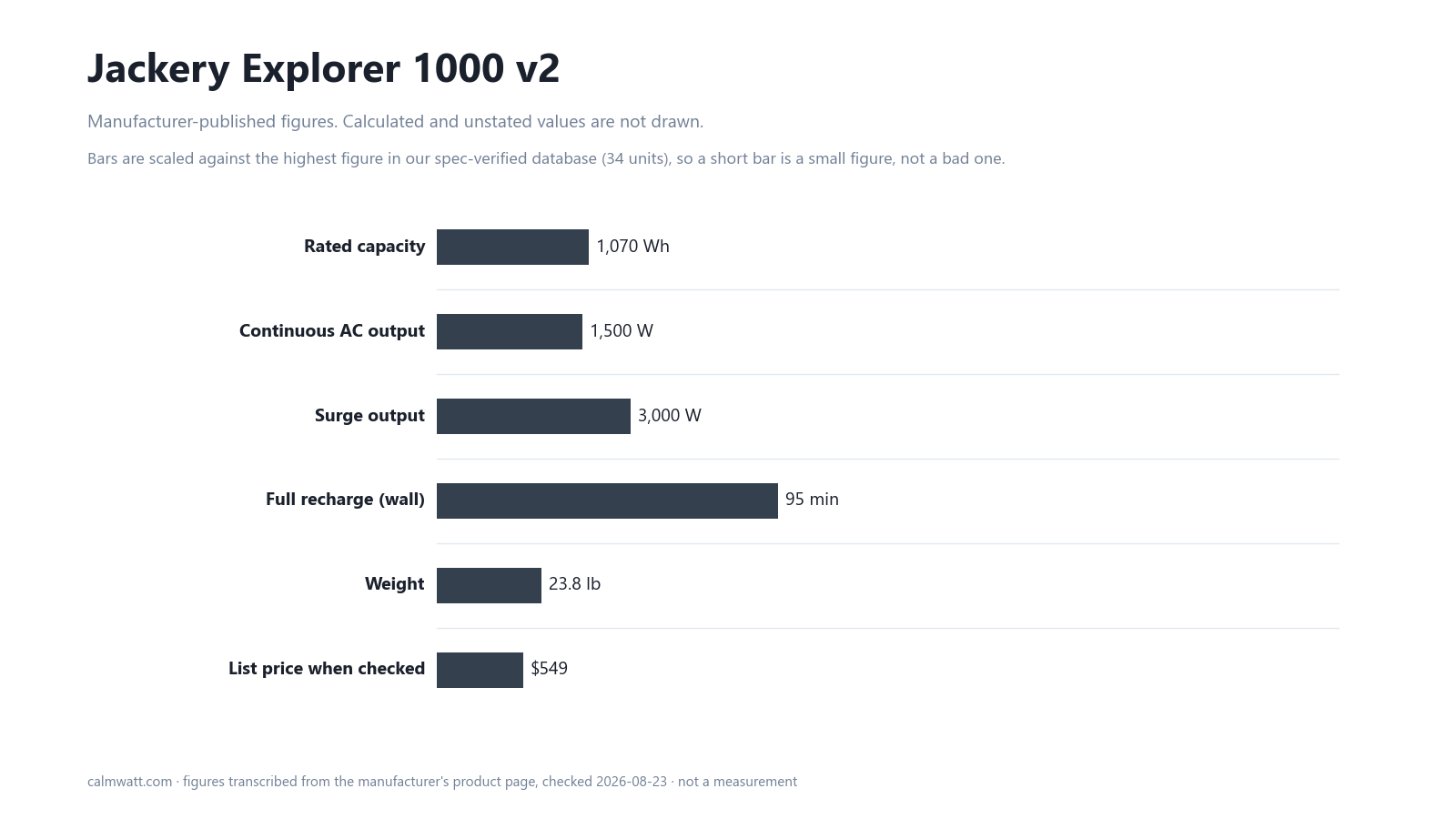
Specifications checked against manufacturer pages on 2026-08-23.
Jackery Explorer 1000 v2: 1,070 Wh of LiFePO4 cells behind a 1,500 W continuous inverter, in the 1 kWh-class size. Checked against the maker’s page on 2026-08-23: every published figure, the runtimes those figures imply, and the specifications Jackery does not publish at all. Nothing here is a bench result, and each calculated number says so on its own row.
In short. 1,070 Wh in the 1 kWh-class band: $0.51/Wh at the list price we recorded; 45.0 Wh per pound; 4,000 rated cycles to 70%+. On our assumptions a full-size refrigerator calculates to 16–18 hr, and a 40 W CPAP calculates to 19–22 hr. Jackery leaves 1 of the rows we track unstated, and we name it rather than filling in a guess. The runtime figures are calculated, not measured.
Check the current price

That link points at the base unit we transcribed, not a kit with panels. Amazon prices change daily.
Who it is for, and who should skip it
The published figures answer this before any opinion does.
It fits if
- A refrigerator is what you are saving. It clears a 12-hour outage on our assumptions with about 4 hours to spare, and the stated 3,000 W surge covers a roughly 900 W start.
- One night of uninterrupted medical equipment. A 40 W machine without a humidifier runs the night with margin, and the maker states under 20 ms on the grid handover. A heated humidifier changes that arithmetic.
- The unit has to move. 23.8 lb is a two-hands lift rather than a cart job, so car to porch to basement is realistic.
Skip it if
- You want resistive heat. A 1,500 W heater empties this unit in about 0.6 hr. That is physics, not a flaw in this model.
- You own a large array already. It takes at most 400 W of solar; panels past that ceiling idle rather than charge it faster.
- Your plan involves house wiring. Nothing portable connects to a panel safely without a transfer switch installed by a licensed electrician. Settle that before buying.
Every published specification
Numbered notes give the source location or a caveat where a figure needs one. “Manufacturer does not state” marks an absence on the maker’s page; “Not yet verified by CalmWatt” marks one of ours.
| Specification | Jackery Explorer 1000 v2 |
|---|---|
| Rated capacity | 1,070 Wh1 |
| Usable capacity (calculated)* | 910–963 Wh |
| Continuous AC output | 1,500 W2 |
| Surge output | 3,000 W3 |
| Full recharge from wall | 95 min4 |
| Cell chemistry | LiFePO45 |
| Rated cycle life | 4,000 cycles to 70%+6,7 |
| UPS switchover | <20 ms8 |
| Expandable | None listed9 |
| Max solar input | 400 W10 |
| Max AC charging input | Manufacturer does not state |
| AC outlets | 311 |
| Highest USB-C port | 100 W12 |
| App control | Yes13 |
| Stated noise | 30 dB14 |
| Warranty | 3 years15 |
| Weight | about 23.8 lb16 |
| Manufacturer list price when checked | $54917 |
* Rated capacity × an assumed 85–90% conversion efficiency. Ours, because nobody publishes one.
Notes on the figures
- Explorer 1000 v2, rated capacity: 30.4Ah/35.2V DC (1070 Wh)
- Explorer 1000 v2, continuous output: 1500W Rated, 3000W Surge peak
- Explorer 1000 v2, surge: 1500W Rated, 3000W Surge peak
- Explorer 1000 v2, full recharge: Jackery’s spec table gives 1.58 hours with the AC adapter; the ‘Emergency Charge 1 Hr’ headline is a faster mode.
- Explorer 1000 v2, cell chemistry: Long-lasting LiFePO₄ cells ensure 10+ years (4,000 charge cycles) backed up by a 5-year warranty.
- Explorer 1000 v2, cycle life: 4000 cycles to 70%+ capacity
- Explorer 1000 v2, cycle life: Jackery rates 4,000 cycles to 70%+ remaining capacity. Some competitors rate to 80%; the cycle counts are not directly comparable.
- Explorer 1000 v2, UPS switchover: Stated as under 20 milliseconds; an upper bound.
- Explorer 1000 v2, expandable: No expansion option appears on the product page; the manufacturer does not explicitly state that none exists.
- Explorer 1000 v2, solar input: (2x) DC 8mm Ports: 12-16V(Working Voltage)⎓8A Max, Double to 8A Max; 16-60V(Working Voltage)⎓10.5A Max, Double to 21A/400W Max
- Explorer 1000 v2, AC outlets: (3x) 120V ~ 60Hz
- Explorer 1000 v2, USB-C: (1x) 100W Max, 5V⎓3A, 9V⎓3A, 12V⎓3A, 15V⎓3A, 20V⎓5A
- Explorer 1000 v2, app: Feature heading ‘Smart App Control And LCD Display’.
- Explorer 1000 v2, noise: Marketing feature block titled ‘Peace and Quiet’.
- Explorer 1000 v2, warranty: Jackery states 3 years standard plus a 2-year extended warranty; per our policy we count the base three years.
- Explorer 1000 v2, weight: Around 23.8 lbs (10.8 kg)
- Explorer 1000 v2, price: Manufacturer’s listed price when checked; may have been a sale price.
What Jackery does not state
What a maker leaves out is a fact about the product too. Every gap on this unit’s page, named rather than quietly filled in. Of the 34 units we have transcribed, 29 omit at least one figure; this one omits 1 figure.
- Maximum ac charging input. Absent from Jackery’s specifications for this unit when we checked.
- Usable capacity. Nobody states this, here or elsewhere. The rating describes the cells, not the outlet, and the difference depends on what you plug in.
Omissions are the industry norm rather than this maker’s failing. The point is that a confident figure for any of them, anywhere, came from somebody’s guess.
What it runs, and for how long
The appliance set is fixed across the site, which is what makes these hours comparable with any other page here.
| Appliance | Explorer 1000 v2 |
|---|---|
| Full-size refrigerator 150 W, 900 W start, 35% duty · eff. 80%–87% |
16–18 hr |
| Mini fridge 70 W, 400 W start, 30% duty · eff. 70%–82% |
36–42 hr |
| CPAP without humidifier 40 W · eff. 70%–82% |
19–22 hr |
| CPAP with heated humidifier 95 W · eff. 80%–87% |
9.0–9.8 hr |
| Gas furnace blower 400 W, 1600 W start, 40% duty · eff. 85%–90% |
5.7–6.0 hr |
| 1/3 hp sump pump 500 W, 1800 W start, 15% duty · eff. 85%–90% |
12–13 hr |
| Router and modem 20 W · eff. 70%–82% |
37–44 hr |
| Laptop 60 W · eff. 70%–82% |
12–15 hr |
| 1500W space heater 1500 W · eff. 82%–88% |
about 0.6 hr |
Calculated, not measured: hours = rated Wh × efficiency ÷ (appliance W × duty). Assumptions: How we verify. “Unlikely to start” means the start-up surge exceeds the stated surge rating.
The same specs, normalized
| Measure | Explorer 1000 v2 |
|---|---|
| Cost per watt-hour | $0.51/Wh |
| Watt-hours per pound | 45.0 Wh/lb |
| Surge headroom | 2.00× |
| Recharge rate | 11.3 Wh/min |
| Rated cycle life | 4,000 cycles to 70%+ |
| Continuous watts per dollar | 2.73 W/$ |
A ratio means something only against another unit’s, so pair these with the head-to-head pages below. Definitions: How we verify.
What those figures actually mean
Cost per watt-hour: $0.51/Wh. The $549 list price we recorded over 1,070 Wh of rated capacity. Capacity alone tells you nothing about value. This does, and it moves every time the price does.
Watt-hours per pound: 45.0 Wh/lb. 1,070 Wh in 23.8 lb makes this a two-hands lift. These cells are heavier per watt-hour than the ones they replaced, and last far longer. That is the trade the cycle rating prices.
Surge headroom: 2.00×. A stated 3,000 W surge over a 1,500 W continuous rating, which covers the roughly 900 W a full-size refrigerator needs to start. A unit with hours to spare and no headroom fails in the first second.
Recharge rate: 11.3 Wh/min. A full wall charge in 95 minutes. Over a long outage, refill speed decides how long an engine runs or a cord stays borrowed.
Rated cycle life: 4,000 cycles to 70%+ capacity. At one cycle a week that is roughly 77 years away, which is another way of saying something else will retire this unit first unless you cycle it daily. The percentage matters as much as the count: two ratings only compare when they name the same remaining capacity.
Continuous watts per dollar: 2.73 W/$. This one moves opposite to cost per watt-hour on most units, so a unit can look good on exactly one of them.
Where it sits in our database
Read against our own database rather than against the maker’s marketing, the figures place like this.
| Measure | Explorer 1000 v2 | Among verified units |
|---|---|---|
| Rated capacity | 1,070 Wh | 18th largest of 34 |
| Continuous AC output | 1,500 W | 25th highest of 34 |
| Cost per watt-hour | $0.51/Wh | 10th cheapest of 32 |
| Watt-hours per pound | 45.0 Wh/lb | 6th densest of 34 |
| Weight | 23.8 lb | 10th lightest of 34 |
These positions describe size and price, not fitness for your outage. The row built on price uses the manufacturer list price recorded on 2026-08-23; the retail price behind our link moves independently, so recompute that row against what you are shown.
Three outages, and the figure that decides each
- One night, one CPAP. A 40 W CPAP without a humidifier calculates to 19–22 hr. The stated under 20 ms handover is what decides whether the machine notices the outage.
- Twelve hours, one refrigerator. A typical full-size refrigerator calculates to 16–18 hr, and the stated 3,000 W surge covers its roughly 900 W start.
- The loads people forget. A gas furnace blower calculates to 5.7–6.0 hr and a one-third horsepower sump pump calculates to 12–13 hr. Both are hard-wired in most houses, which makes this an electrician’s question before it is a battery one. A router and modem, meanwhile, calculates to 37–44 hr.
- Three days, with something to recharge from. A full wall recharge takes 95 minutes, and it accepts up to 400 W of solar, so day two turns on your panels and your sky.
The Explorer 1000 v2 against other units
A single unit’s ratios mean little alone. These 7 head-to-head pages put the Explorer 1000 v2 against another unit on the same figures.
- Anker SOLIX C1000 Gen 2 vs Jackery Explorer 1000 v2
- Anker SOLIX C1000 vs Jackery Explorer 1000 v2
- Bluetti AC180 vs Jackery Explorer 1000 v2
- Bluetti AC70 vs Jackery Explorer 1000 v2
- Bluetti Elite 100 V2 vs Jackery Explorer 1000 v2
- EcoFlow DELTA 2 vs Jackery Explorer 1000 v2
- EcoFlow DELTA 3 vs Jackery Explorer 1000 v2
Questions people ask about the Explorer 1000 v2
Every answer below comes from the tables above.
How long will the Explorer 1000 v2 run a refrigerator?
16–18 hr on our assumptions for a typical full-size unit at 150 W running and a 35% duty cycle. The stated surge covers the roughly 900 W start. Substitute the wattage from the label inside your door.
Can the Explorer 1000 v2 run a CPAP all night?
Yes on capacity: a 40 W machine without a humidifier calculates to 19–22 hr against the eight hours a night usually needs. The maker states under 20 ms on the handover. Add a heated humidifier and the hours roughly halve.
How long does the Explorer 1000 v2 take to recharge?
95 minutes from a wall outlet on the maker’s figure, with up to 400 W accepted from solar. That is the figure that matters once the outage passes a day.
How much does the Explorer 1000 v2 weigh?
23.8 lb on the maker’s figure, or 45.0 Wh of rated capacity carried per pound. That is a two-hands lift, which is why units this size tend to stay where you put them.
How many cycles is the Explorer 1000 v2 rated for?
4,000 cycles to 70%+ of original capacity, on LiFePO4 cells, which is roughly 77 years at one cycle a week. A figure quoted to a different retention level is a different promise, not a better one.
Will the Explorer 1000 v2 run a space heater?
It will, and it will empty the battery in about 0.6 hr. Resistive heat drains any battery this size faster than anything else you can plug in.
Check the current price
That link points at the base unit we transcribed, not a kit with panels. Amazon prices change daily.
Related reading
The honest comparison is not with a bigger battery but with an engine: a 1,500 W space heater empties it in about 0.6 hr, yet nothing here vents carbon monoxide into a garage. How often gasoline generators kill indoors — and how the official count keeps being revised — is documented in our CPSC revision matrix, while our refrigerator hub ranks every unit we have verified on the same twelve hours.
Ordering before a storm? Check the arrival date at checkout — a unit that ships tomorrow can beat a better one that ships next week. Amazon Prime includes fast delivery on eligible items and starts with a free trial; we earn a commission if you join.
Sources and method
- Jackery Explorer 1000 v2: manufacturer product page, checked 2026-08-23.
Every quoted number comes from the maker’s page with its source sentence recorded. Every calculated number is marked as such and uses the formula above. Method: How we verify. More: Comparisons.