The short version. We count 44 recall notices in the U.S. Consumer Product Safety Commission’s database that match a portable generator or a battery power station (our keyword search and classification, not a CPSC category). 8 are battery power stations, and 5 of those came since 2023, covering about 87,270 U.S. units. The newest is the Goal Zero Recalls YETI 3000X Power Stations Due to Serious Risk of Injury from Fire and Burn Hazards (2026-08-20). Of the 8 battery-unit recalls, 7 cite fire or burn hazards. CPSC publishes recalls one page at a time and offers no category-level table; this is that table, with the CSV.
What this is
Every recall in the U.S. Consumer Product Safety Commission’s database that we could match to a portable generator or a battery power station, compiled from CPSC’s own recall API and sorted by date. Title, hazard and remedy are CPSC’s wording, copied without abridgement. What is ours is the three-way classification — engine-driven generator, battery power station, or generator of unclear type — assigned from the recall title, the product names and the hazard sentence. Where those do not say whether a generator is engine-driven, we mark it unclear rather than guess. Rows that are reannouncements, recall alerts, engine-only or accessory recalls are flagged in the table and in the CSV.
Battery power station recalls
| Date | Recall (CPSC title, linked) | Units | Hazard (CPSC wording) |
|---|---|---|---|
| 2026-08-20 | Goal Zero Recalls YETI 3000X Power Stations Due to Serious Risk of Injury from Fire and Burn Hazards | About 46,200 | The recalled power station’s circuit board can overheat, posing a risk of serious injury from fire and burn hazards. |
| 2025-10-09 | EcoFlow Technology Recalls Delta Max 2000 Power Stations Due to Risk of Serious Burn Injury and Fire Hazard | About 25,030 | The Power Stations may overheat and ignite, posing a risk of serious burn injury and fire hazard. |
| 2025-07-03 | Harbor Freight Tools Recalls Predator 2000-Watt Power Stations Due to Shock Hazard | About 6,500 | The wires in the power station’s AC outlet receptacles are reversed when the product is in Emergency Power Supply (“EPS”) mode, posing a shock hazard to consumers operating the power station. |
| 2024-08-29 | HALO 1000 Portable Power Stations Recalled Due to Serious Fire and Burn Hazards; One Death Reported; Imported by ZAGG; Sold by ACG, QVC and ZAGG | About 5,740 | The lithium-ion batteries in the HALO 1000 Portable Power Station can overheat, posing fire and burn hazards that can lead to serious injury or death. |
| 2023-12-21 | Klein Tools Recalls Blackfire and Klein Tools Power Stations Due to Fire and Burn Hazards | About 3,800 (In addition, about 164 were sold in Canada) | The top and bottom of the internal inverter boards of the power stations can overheat, posing fire and burn hazards. |
| 2022-11-03 | Power Plus Recalls Tora Portable Power Charging Stations Due to Fire and Explosion Hazards | About 115 | The lithium-ion battery in the recalled portable power charging stations can catch on fire while charging, posing fire and explosion hazards. |
| 2016-07-28 | Lekker Recalls Patriot Power Generators Due to Fire Hazard; Sold Exclusively Online at 4Patriots.com | About 2,200 | The battery sold with the generator can catch fire, posing a fire hazard to the user or bystanders. |
| 2009-04-02 | Best Buy Announces the Recall of Certain Rocketfish Universal Portable Power Sources Due to Fire Hazard | About 1,400 | While charging the battery, the power source can unexpectedly ignite, posing a fire hazard to consumers. |
Remedies are in the CSV and on each linked CPSC page. Dates are CPSC’s announcement dates; CPSC numbers and files recalls by federal fiscal year (October–September), so a recall announced in October–December carries the next year’s number and URL.
Recalls by year
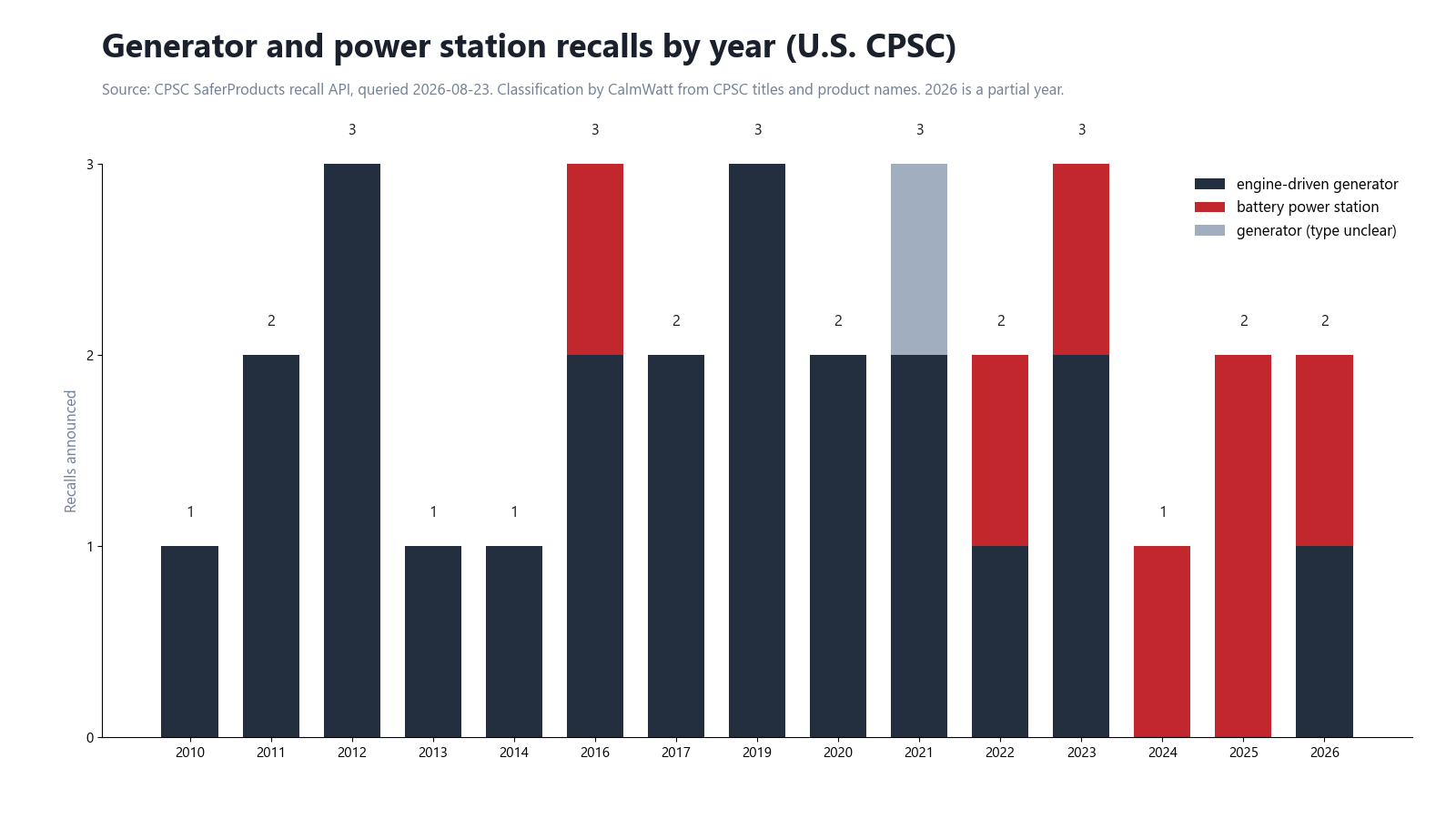
| Year | Engine-driven generators | Battery power stations | Generator, type unclear |
|---|---|---|---|
| 2010 | 1 | 0 | 0 |
| 2011 | 2 | 0 | 0 |
| 2012 | 3 | 0 | 0 |
| 2013 | 1 | 0 | 0 |
| 2014 | 1 | 0 | 0 |
| 2015 | 0 | 0 | 0 |
| 2016 | 2 | 1 | 0 |
| 2017 | 2 | 0 | 0 |
| 2018 | 0 | 0 | 0 |
| 2019 | 3 | 0 | 0 |
| 2020 | 2 | 0 | 0 |
| 2021 | 2 | 0 | 1 |
| 2022 | 1 | 1 | 0 |
| 2023 | 2 | 1 | 0 |
| 2024 | 0 | 1 | 0 |
| 2025 | 0 | 2 | 0 |
| 2026 | 1 | 1 | 0 |
Grouping the hazard sentences by keyword across all 44 notices: fire or burn (36), shock or electrocution (4), laceration, pinch or crush (2), other (2). 2 of the 44 are CPSC reannouncements of an earlier recall and are flagged as such; they are counted as separate notices here because CPSC issues them as separate notices.
How this was compiled
We queried CPSC’s public recall API (saferproducts.gov/RestWebServices/Recall) on 2026-08-23 for the terms
generator, power station, portable power, solar generator, inverter generator, power bank, merged the results by recall number, and removed products that are not generators or power stations by our definition — phone power banks, wireless charging stands, pool and spa UV “generators”, ozone and steam generators, an electronics teaching kit sold as a “function generator”, and a corded LED work light sold as a “power station”. Each remaining notice was classified from its title, product names and hazard sentence. 3 mention a generator without stating whether it is engine-driven; they are listed as “type unclear” rather than forced into a category. The dropped notices are listed in a separate file so the filter can be audited.
Scope, and what this does not show
- No denominator. There is no published count of power stations or generators in use, so nothing here supports a recall rate, a risk per unit, or a comparison between brands. A brand with more recalls may simply sell more units.
- Recalls, not incidents. A recall is an agreed corrective action, not a count of fires or injuries. CPSC’s incident data is a separate series.
- CPSC’s search is keyword-based. A recall that names the product without any of our search terms would not appear. We re-run the query and refresh this page; the date at the top is the query date.
- Units are CPSC’s “about” figures, copied as printed; sums on this page use the U.S. figure only, and where CPSC adds a Canadian figure in the same sentence we keep it in the cell. “Not stated” means CPSC gave no number.
How to cite this data
Download: cwt_generator_power_station_recalls.csv (44 rows; opens in pandas or Excel; comment lines begin with #).
Attribution: “CalmWatt Research compilation of U.S. CPSC recall data, 2026-08-23.” Free to quote or republish with a link to this page.
Reporters: every row carries the CPSC recall number and URL, so each figure can be checked against the agency’s own page without trusting us.
Ready-to-quote sentence: “CPSC has announced 8 recalls of battery power stations since 2009, 5 of them since 2023 covering about 87,270 U.S. units, according to a CalmWatt Research compilation of the agency’s recall database.”
Questions owners and reporters ask
Has my power station been recalled?
Check the table for your brand and model, then confirm on the linked CPSC page, which lists the exact model numbers and date codes. Our table can miss a recall whose notice uses none of our search terms, and manufacturers sometimes issue safety notices that are not CPSC recalls, so also check the maker’s support page and CPSC’s own recall search.
Are battery power stations recalled more often than gas generators?
By count, no: 33 engine-driven generator recalls against 8 battery power station recalls in CPSC’s database. But the battery category is much younger — 5 of its 8 recalls are from 2023 onward — and we have no sales denominator for either, so this is not a rate.
What should I do if my unit is on the list?
Follow the remedy in CPSC’s own recall notice (linked in each row); the remedy column here is CPSC’s summary. Stop using the unit if the notice says so.
How often is this page updated?
We re-query the CPSC API at least quarterly and whenever a new generator or power station recall appears in CPSC’s recall feed, which we read. The query date is shown at the top and in the CSV header.
Related: generator carbon monoxide deaths: the CPSC revision matrix · which power stations run a refrigerator through a 12-hour outage · how we verify figures