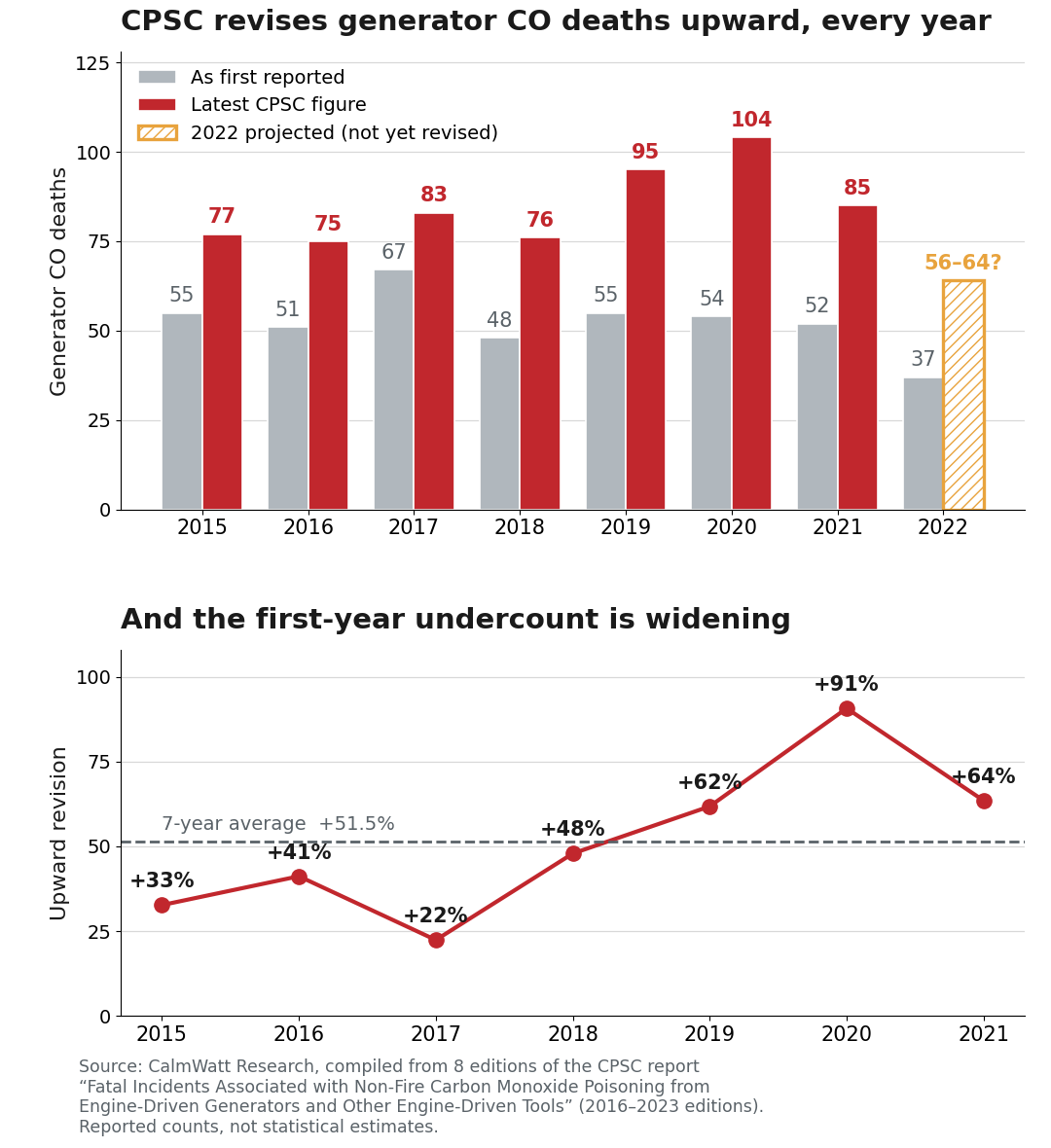
The short version. Every year since 2015, the U.S. Consumer Product Safety Commission has revised its generator carbon monoxide death count upward after first publishing it — by an average of 51.5%. The largest revision, for 2020, was +90.7%: 54 deaths became 104.
The most recent edition of this report — July 2023, covering 2012–2022 — lists 37 generator CO deaths for 2022. No later edition has revised it. A separate CPSC series published in May 2026 estimates 93 generator deaths for the same year; the two series count different things, and both are explained below.
Figures re-checked against CPSC publications on 2026-09-12.
The official number, and what happens to it
CPSC publishes an annual report counting deaths from non-fire carbon monoxide poisoning caused by portable generators and other engine-driven tools. Each edition covers an eleven-year window and is released as a PDF. Because the windows overlap, the same incident year appears in several editions — and comparing them shows something no single report does.
The most recent year is always too low when it is first published, and the gap has been widening. CPSC says so itself, in prose: its July 2023 edition states that counts for the most recent year have risen by an average of about 51 percent from the previous year’s report. What the agency does not publish is the year-by-year table. That table is below.
| Incident year | As first published | Latest CPSC figure | First revision |
|---|---|---|---|
| 2015 | 55 | 77 | +32.7% |
| 2016 | 51 | 75 | +41.2% |
| 2017 | 67 | 83 | +22.4% |
| 2018 | 48 | 76 | +47.9% |
| 2019 | 55 | 95 | +61.8% |
| 2020 | 54 | 104 | +90.7% |
| 2021 | 52 | 85 | +63.5% |
| 2022 | 37 | not revised yet | — |
Two things stand out. Every year was revised upward — none was revised down. And the size of the first revision has grown, from +22.4% for 2017 to +90.7% for 2020, with the three most recent years averaging +72.0%.
Older years do not move. Every incident year from 2005 through 2011 carries an identical count in every edition that reported it. This is a recency effect, not churn in the underlying data.
What this implies for 2022 — and how we got there
PROJECTION — not a CPSC figure.
The official 2022 count is 37. Applying CPSC’s own revision history to it gives:
- seven-year average revision (+51.5%) → about 56
- average of the three most recent years (+72.0%) → about 64
Calculated 2026-08-23 from the 8 editions listed below. We will replace this projection with the actual number when CPSC publishes its next edition.
For reporters — a line you can quote:
Federal data records 37 generator-related carbon monoxide deaths in 2022, but that figure is provisional — CPSC has revised its first-published count upward by an average of 51% since 2015, which would put the year nearer 56–64.
How this was compiled
We collected every edition of the report listed on CPSC’s carbon monoxide research page and read the year-by-year table in each: the June editions of 2016, 2017, 2018, 2019, 2020, 2021 and 2022, and the July 2023 edition.
Values were transcribed from the published tables. The downloadable file carries the exact source line each value was read from, so a transcription error has to be visible in the quoted line rather than hiding as a plausible-looking number. Column totals were checked against the printed totals in every edition.
A discrepancy in the source
That check surfaced one arithmetic discrepancy. In the July 2023 edition, the Total row of the year-by-year table prints all-tool deaths as 87. The eleven yearly figures in the same table sum to 872, and the same row’s generator total (789) plus other-tool total (83) also gives 872. The remaining five cells of that Total row match their column sums exactly. Three independent PDF text extractors return 87, so this is what the document says. We use 872 and note the difference here.
Two CPSC series, two different numbers for 2022
CPSC counts generator carbon monoxide deaths in two separate publication series. They do not agree, and both are official.
- Reported counts — the series this page tracks. The annual engine-driven-tools report, whose July 2023 edition covers 2012–2022 and lists 37 for 2022. Every figure in the table above comes from this series.
- National estimates — a separate series. CPSC’s Non-Fire Carbon Monoxide Deaths Associated with the Use of Consumer Products — 2022 Annual Estimates, published May 2026, states: “Ninety-three (93) of the 107 estimated EDT-associated deaths involved generators.” The same report adds that “An estimated 71 deaths were associated with gasoline-fueled generators alone.”
One counts incidents reported to the agency; the other estimates a national total. They are not interchangeable and neither replaces the other. The 56–64 projection above is arithmetic applied to the reported-count series only. It is not a forecast of the national estimate, which for 2022 is already 93.
Scope, and what this does not show
- Reported counts, not estimates. CPSC states the data are anecdotal and that no statistical inference about the trend is possible. The agency publishes a separate statistical-estimate series; the two are not comparable and are not combined here.
- No denominator. There is no published count of generators in use, so nothing here supports a failure rate, a risk-per-unit, or a comparison between brands.
- Generators only. The reports also cover other engine-driven tools; those figures are in the full file but are not mixed into the generator series.
- A small number of stationary generators are included in some years — CPSC footnotes three incidents in 2011 and one in 2015.
- We make no causal claim about why reporting lags. CPSC attributes it to reporting delays and, for recent years, to pandemic-related delays.
How to cite this data
Free to quote, republish, or build on. We ask only for a link.
Suggested citation:
Generator carbon monoxide death counts compiled by CalmWatt Research from 8 editions of the U.S. Consumer Product Safety Commission report on non-fire CO poisoning from engine-driven generators.
Download:
- Revision matrix (CSV) — one row per incident year, every edition as a column
- All observations (CSV) — every value with the source line it was read from
Reporters: we can cut this by year, by edition, or against a specific storm on request. Ask and we will send it.
Questions
How many people die each year from generator carbon monoxide poisoning?
CPSC’s most recent report counts 104 generator-related non-fire CO deaths for 2020, its highest year on record. The 2018–2020 average is about 92. These are counts of reported incidents, not statistical estimates.
Why does CPSC change the numbers after publishing them?
Reports reach CPSC over several years — death certificates, incident reports and in-depth investigations arrive late. The agency marks the most recent year as incomplete when it first publishes, and revises upward in later editions.
How large is the revision, typically?
Across the seven incident years we could measure (2015–2021), the first published generator death count rose by an average of 51.5% in the following edition. The smallest was +22.4% (2017); the largest was +90.7% (2020).
Is the 2022 figure of 37 final?
No. It appeared in the July 2023 edition and no later edition of that series has been published. Applying CPSC’s own revision history gives a projected 56–64. That is our arithmetic, not a CPSC figure. CPSC’s separate national-estimate series, published May 2026, already puts 2022 generator deaths at an estimated 93.
Do older years keep moving?
No. Every incident year from 2005 through 2011 carries an identical count in every edition that reported it. The movement is a recency effect, not churn in the underlying data.
Can I use this data?
Yes. Quote it, republish it, or build on it with attribution to CalmWatt Research and a link. The CSV carries the exact source line each value was read from.
Which reports did you use?
Eight editions of the CPSC report on non-fire CO poisoning from engine-driven generators, published between June 2016 and July 2023.
Related: how we verify figures · about CalmWatt · contact the editorial team