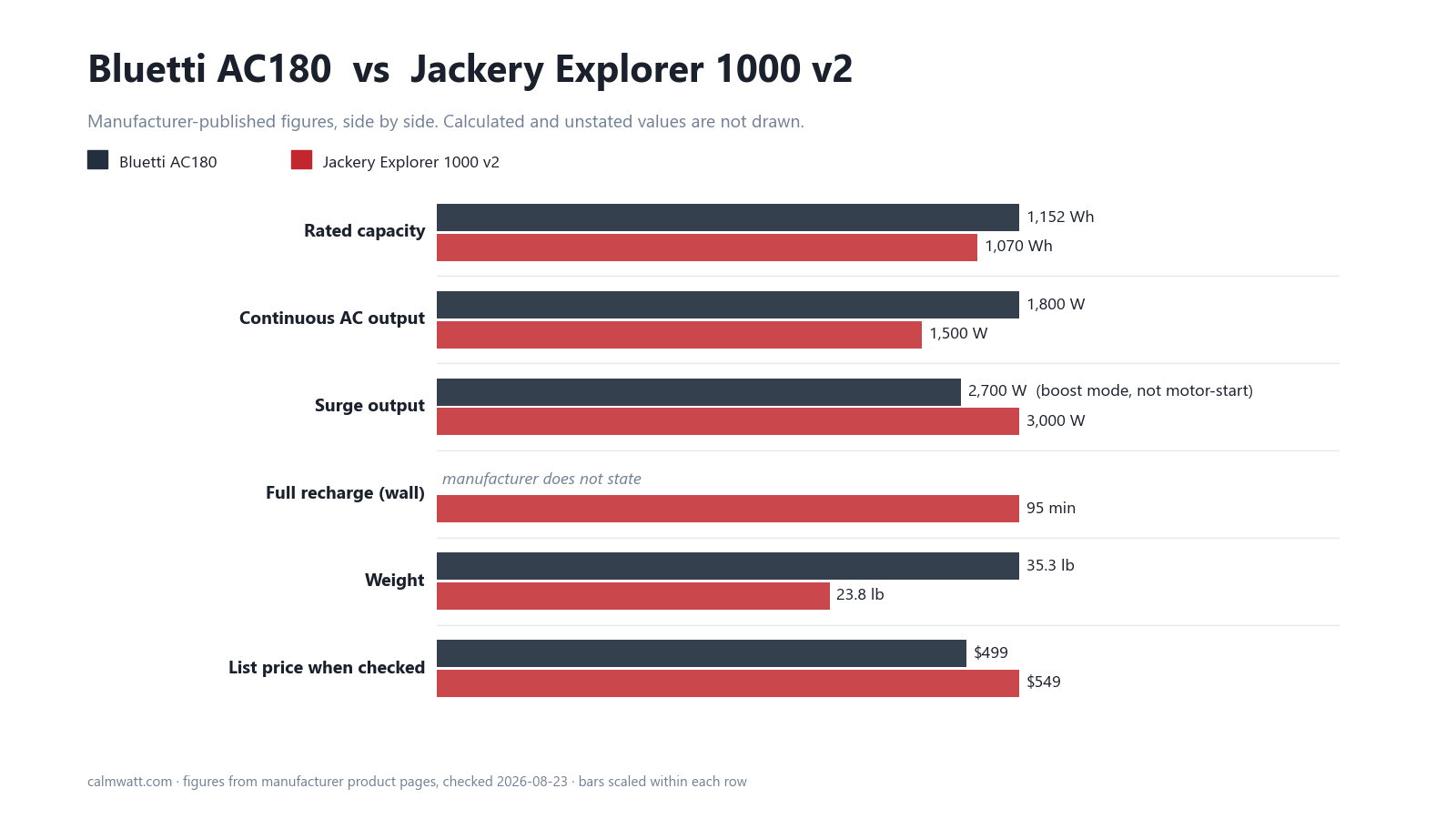
Specifications checked against manufacturer pages on 2026-08-23.
The Bluetti AC180 (1,152 Wh, 1,800 W) and the Jackery Explorer 1000 v2 (1,070 Wh, 1,500 W), compared on the figures their makers publish. On the normalized ratios, the AC180 costs less per watt-hour ($0.43/Wh vs $0.51/Wh); the Explorer 1000 v2 carries more per pound (45.0 Wh/lb vs 32.6 Wh/lb).
In short. The AC180 leads on cost per watt-hour ($0.43/Wh vs $0.51/Wh) and continuous watts per dollar (3.61 W/$ vs 2.73 W/$). The Explorer 1000 v2 leads on watt-hours per pound (45.0 Wh/lb vs 32.6 Wh/lb). 3 of 6 measures tie or are not comparable.
Check the current price


Links go to the exact base unit we compared, not a bundle. Amazon prices change daily.
Specifications, side by side
Numbered notes below the table give the source location or a caveat for figures that need one; check marks mark the better figure where one can be judged; “Manufacturer does not state” means absent from that maker’s page as of its check date listed under Sources. UPS switchover is how long the outlets go dark when grid power drops.
| Specification | Bluetti AC180 | Jackery Explorer 1000 v2 |
|---|---|---|
| Rated capacity | 1,152 Wh1 ✓ | 1,070 Wh2 |
| Usable capacity (calculated)* | 979–1037 Wh | 910–963 Wh |
| Continuous AC output | 1,800 W3 ✓ | 1,500 W4 |
| Surge output | No conventional surge stated (2,700 W boost mode)5 | 3,000 W6 |
| Full recharge from wall | Manufacturer does not state (0–80% in 45 min)7 | 95 min8 |
| Cell chemistry | LiFePO49 | LiFePO410 |
| Rated cycle life | 3,500+ cycles to 80%11 | 4,000 cycles to 70%+12,13 |
| UPS switchover | Manufacturer does not state | <20 ms14 |
| Expandable | No15 | None listed16 |
| Max solar input | 500 W17 ✓ | 400 W18 |
| Max AC charging input | 1,440 W19 | Manufacturer does not state |
| AC outlets | 420 ✓ | 321 |
| Highest USB-C port | 100 W22 | 100 W23 |
| App control | Yes24 | Yes25 |
| Stated noise | Manufacturer does not state | 30 dB26 |
| Warranty | 5 years27 | 3 years28 |
| Weight | 35.3 lb29 | about 23.8 lb30 ✓ |
| Manufacturer list price when checked | $49931 ✓ | $54932 |
* Calculated: rated capacity × an assumed 85–90% conversion efficiency; no maker publishes a usable figure.
Notes on the figures
- AC180, rated capacity: 1,152Wh (AC180) / 1,440Wh (AC180P)
- Explorer 1000 v2, rated capacity: 30.4Ah/35.2V DC (1070 Wh)
- AC180, continuous output: 4 x 120V/15A 1800W In Total
- Explorer 1000 v2, continuous output: 1500W Rated, 3000W Surge peak
- AC180, surge: The spec table labels this “Surge Power”, but the same 2,700 W figure is Bluetti’s Power Lifting Mode for resistive heating loads (FAQ Q1: “AC180 can run high-power heating devices up to 2,700W … Do NOT use this unit to run an air conditioner or washing machine.”). Treat as a boost mode for resistive loads; it is not a conventional motor-start surge rating and should not be read as one.
- Explorer 1000 v2, surge: 1500W Rated, 3000W Surge peak
- AC180, recharge: Bluetti publishes a 0–80% time (45 minutes), not a full-charge time.
- Explorer 1000 v2, full recharge: Jackery’s spec table gives 1.58 hours with the AC adapter; the ‘Emergency Charge 1 Hr’ headline is a faster mode.
- AC180, cell chemistry: LiFePO₄ (Lithium Iron Phosphate)
- Explorer 1000 v2, cell chemistry: Long-lasting LiFePO₄ cells ensure 10+ years (4,000 charge cycles) backed up by a 5-year warranty.
- AC180, cycle life: 3,500+ Cycles to 80% Original Capacity
- Explorer 1000 v2, cycle life: 4000 cycles to 70%+ capacity
- Explorer 1000 v2, cycle life: Jackery rates 4,000 cycles to 70%+ remaining capacity. Some competitors rate to 80%; the cycle counts are not directly comparable.
- Explorer 1000 v2, UPS switchover: Stated as under 20 milliseconds; an upper bound.
- AC180, expandable: Bluetti’s B-series batteries can charge the AC180 but do not extend its capacity as a single system.
- Explorer 1000 v2, expandable: No expansion option appears on the product page; the manufacturer does not explicitly state that none exists.
- AC180, solar input: Solar Input: 500W Max., VOC 12-60VDC, 10A
- Explorer 1000 v2, solar input: (2x) DC 8mm Ports: 12-16V(Working Voltage)⎓8A Max, Double to 8A Max; 16-60V(Working Voltage)⎓10.5A Max, Double to 21A/400W Max
- AC180, AC input: Turbo Mode figure from SPECS > INPUT.
- AC180, AC outlets: From SPECS > OUTPUT.
- Explorer 1000 v2, AC outlets: (3x) 120V ~ 60Hz
- AC180, USB-C: From SPECS > OUTPUT.
- Explorer 1000 v2, USB-C: (1x) 100W Max, 5V⎓3A, 9V⎓3A, 12V⎓3A, 15V⎓3A, 20V⎓5A
- AC180, app: Bluetooth only; the page does not claim Wi-Fi.
- Explorer 1000 v2, app: Feature heading ‘Smart App Control And LCD Display’.
- Explorer 1000 v2, noise: Marketing feature block titled ‘Peace and Quiet’.
- AC180, warranty: From SPECS > GENERAL.
- Explorer 1000 v2, warranty: Jackery states 3 years standard plus a 2-year extended warranty; per our policy we count the base three years.
- AC180, weight: Bluetti’s page gives 35.3 lb in the spec table and 37 lb in the description; we use the spec table.
- Explorer 1000 v2, weight: Around 23.8 lbs (10.8 kg)
- AC180, price: Manufacturer price when checked; no separate list price was shown.
- Explorer 1000 v2, price: Manufacturer’s listed price when checked; may have been a sale price.
The same specs, normalized
Ratios, so the bigger unit does not win by default.
| Measure | AC180 | Explorer 1000 v2 |
|---|---|---|
| Cost per watt-hour | $0.43/Wh ✓ | $0.51/Wh |
| Watt-hours per pound | 32.6 Wh/lb | 45.0 Wh/lb ✓ |
| Surge headroom | Not comparable — the AC180 figure is a boost-mode rating, not a motor-start surge. | |
| Recharge rate | Not comparable — Bluetti does not state a full-recharge time for the AC180. | |
| Rated cycle life | Not comparable — rated to different remaining-capacity thresholds (80% vs 70%). | |
| Continuous watts per dollar | 3.61 W/$ ✓ | 2.73 W/$ |
Definitions and direction of each ratio: How we verify.
What each one runs, for how long
| Appliance | AC180 | Explorer 1000 v2 |
|---|---|---|
| Full-size refrigerator 150 W, 900 W start, 35% duty · eff. 80%–87% |
18–19 hr | 16–18 hr |
| Mini fridge 70 W, 400 W start, 30% duty · eff. 70%–82% |
38–45 hr | 36–42 hr |
| CPAP without humidifier 40 W · eff. 70%–82% |
20–24 hr | 19–22 hr |
| CPAP with heated humidifier 95 W · eff. 80%–87% |
9.7–10.5 hr | 9.0–9.8 hr |
| Gas furnace blower 400 W, 1600 W start, 40% duty · eff. 85%–90% |
6.1–6.5 hr | 5.7–6.0 hr |
| 1/3 hp sump pump 500 W, 1800 W start, 15% duty · eff. 85%–90% |
13–14 hr (start-up not assessed) | 12–13 hr |
| Router and modem 20 W · eff. 70%–82% |
40–47 hr | 37–44 hr |
| Laptop 60 W · eff. 70%–82% |
13–16 hr | 12–15 hr |
| 1500W space heater 1500 W · eff. 82%–88% |
0.6–0.7 hr | about 0.6 hr |
Calculated, not measured: hours = rated Wh × efficiency ÷ (appliance W × duty); assumptions on How we verify. “Unlikely to start”: start-up surge exceeds the stated surge rating. “Start-up not assessed” appears where the start-up draw meets or exceeds the unit’s continuous rating and the unit states no conventional motor-start surge to check it against (AC180); the hours assume the motor starts.
What the differences mean
Price per watt-hour. At the list prices we checked, the AC180 costs $0.43/Wh against $0.51/Wh for the Explorer 1000 v2. At list the AC180 is $50 cheaper ($499 vs $549) for 1,152 Wh vs 1,070 Wh. Prices move with sales; the ratio moves with them.
Weight for the capacity. The Explorer 1000 v2 carries 45.0 Wh/lb against 32.6 Wh/lb for the AC180. Both are two-hands-and-a-flat-surface units; the difference matters if the unit moves between car, porch and basement.
Output for the money. 3.61 W/$ on the AC180 against 2.73 W/$ on the Explorer 1000 v2: this is the ratio to read if your outage plan is one big appliance, not many small ones.
Which one, and for whom
On normalized measures the AC180 leads on cost per watt-hour ($0.43/Wh vs $0.51/Wh) and continuous watts per dollar (3.61 W/$ vs 2.73 W/$). The Explorer 1000 v2 answers on watt-hours per pound (45.0 Wh/lb vs 32.6 Wh/lb). The deciding figure is the one your own outage will test first:
- CPAP overnight. Switchover: AC180 no UPS figure stated, Explorer 1000 v2 under 20 ms. A 40 W CPAP runs roughly 20–24 hr on the AC180 and 19–22 hr on the Explorer 1000 v2. Both run the night; the AC180 states no UPS figure, which matters more overnight than the hour difference.
- Keeping a refrigerator cold. The compressor has to start before hours matter. The AC180 states a boost figure rather than a motor-start surge rating; the Explorer 1000 v2 states a 3,000 W surge rating. A full-size refrigerator needs about 900 W to start.
- A multi-day outage with a generator or solar to recharge from. Full recharge: AC180 0–80% in 45 min (no full-charge time stated), Explorer 1000 v2 95 min. These are not comparable: Bluetti states no full-charge time for the AC180.
Check the current price
Links go to the exact base unit we compared, not a bundle. Amazon prices change daily.
Related reading
A 1,070–1,152 Wh battery cannot do what a gasoline generator does — the runtime table shows a 1,500 W space heater emptying either unit in 0.6–0.7 hr — but it also cannot poison a household. How often gasoline generators kill indoors — and how the official count keeps being revised — is documented in our CPSC revision matrix, and this page puts every verified unit on the same refrigerator scenario.
Other comparisons with these models
Ordering before a storm? Check the arrival date at checkout — a unit that ships tomorrow can beat a better one that ships next week. Amazon Prime includes fast delivery on eligible items and starts with a free trial; we earn a commission if you join.
Sources and method
- Bluetti AC180: manufacturer product page, checked 2026-08-23.
- Jackery Explorer 1000 v2: manufacturer product page, checked 2026-08-23.
Published specifications only; no bench tests. Method: How we verify. More: Comparisons.