
Specifications checked against manufacturer pages on 2026-08-23.
In a winter outage the gas is usually still on; what stops is the blower motor that pushes the heat through the ducts. That motor is a harder load than a refrigerator on both counts — it draws more when running and far more when starting — so a power station that carries a fridge overnight can still fail here. This page puts every unit in our spec-verified database through the same furnace-blower scenario and says, for each, what the manufacturer’s own figures allow us to conclude.
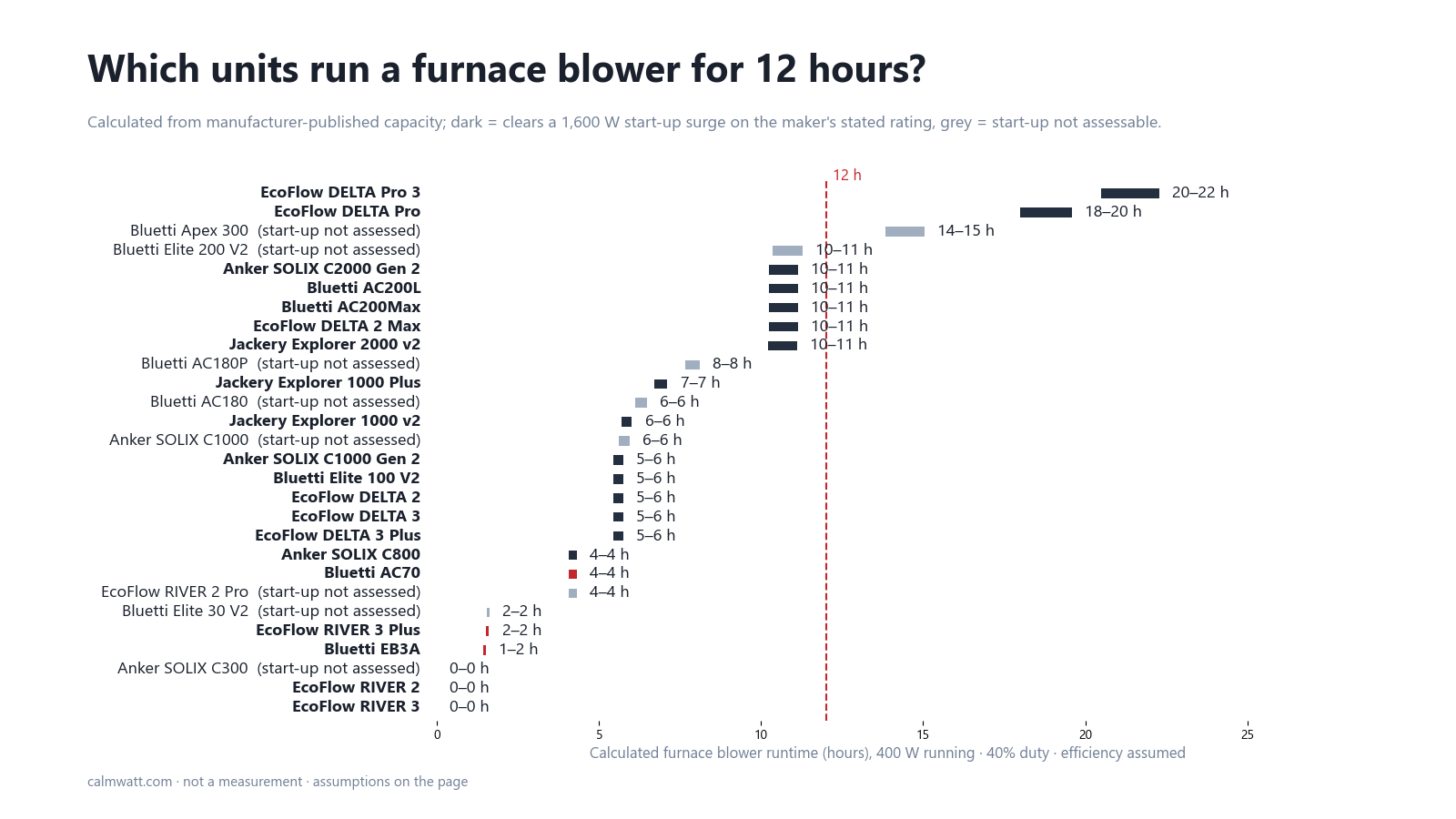
In short. Three of the 28 units carry a typical furnace blower (400 W running, 1600 W start, running 40% of the time) past 12 hours on our assumptions — from 14–15 hours on the Apex 300 to 20–22 on the DELTA Pro 3. Three units — C300, RIVER 2, RIVER 3 — cannot carry the 400 W running load at all, so start-up never arises for them. Start-up is the first test, and 20 of the 25 that can carry the load clear it: DELTA Pro 3, DELTA Pro, Apex 300, Elite 200 V2, C2000 Gen 2, AC200L, AC200Max, DELTA 2 Max, Explorer 2000 v2, AC180P, Explorer 1000 Plus, AC180, Explorer 1000 v2, C1000, C1000 Gen 2, Elite 100 V2, DELTA 2, DELTA 3, DELTA 3 Plus, C800 (five of those on their continuous rating alone, because the maker states no conventional surge figure). AC70, RIVER 3 Plus, EB3A state a surge rating below the start-up draw. For RIVER 2 Pro, Elite 30 V2 the published figures do not let us say. Note that the DELTA 2 has left its maker’s catalog (checked 2026-08-23). Note that the EB3A is marked discontinued on its maker’s store (checked 2026-08-24). Note that the C800 is no longer listed new on its maker’s US store (checked 2026-08-24).
Before the wattage question: a furnace is hard-wired. A gas furnace is normally hard-wired rather than plugged into a wall outlet, so in most installations none of the runtimes below can be reached with an extension cord. Feeding a hard-wired appliance from any portable power source requires equipment installed by a licensed electrician — typically a transfer switch or an interlock. Connecting a power source to house wiring without one can push current back onto the utility line and kill someone working on it. We publish the electrical figures; the connection is not a do-it-yourself question and we do not give wiring instructions. Ask an electrician what your furnace needs before buying anything for this job.
Why start-up comes before runtime
A motor draws a brief surge when it starts — for a typical furnace blower we assume about 1,600 W, against roughly 400 W once running. A power station whose inverter cannot supply that surge will trip, and the battery’s capacity never enters the picture. That is why the table puts start-up in the first column and runtime in the second. Where a manufacturer states a surge rating, we compare it with 1,600 W. Where it states none, or states a resistive-load boost figure rather than a motor-start rating, we fall back to the continuous rating: any load below the continuous rating is deliverable by definition, so a 1,600 W start is covered by an inverter whose continuous rating exceeds it — by a wide margin on some of these units and a narrow one on others; each row shows its own. Only when neither figure settles it do we say the start-up cannot be assessed. A blower start-up is roughly double a refrigerator’s, which is why several units that clear the fridge test do not clear this one.
Every spec-verified unit, one gas furnace blower, same 12 hours
Sorted by furnace blower runtime; assumptions are under the table.
| Unit | Furnace blower start-up | Furnace blower runtime | Runs 12 hours? | Full-size refrigerator | 1/3 hp sump pump | Router and modem |
|---|---|---|---|---|---|---|
| EcoFlow DELTA Pro 3 4,096 Wh · 4,000 W continuous |
Clears 1600 W start (8,000 W surge stated) | 20–22 hr | Yes | 2.3–2.7 days | 44–48 hr | 6.0–7.0 days |
| EcoFlow DELTA Pro 3,600 Wh · 3,600 W continuous |
Clears 1600 W start (7,200 W surge stated) | 18–20 hr | Yes | 2.0–2.3 days | 38–42 hr | 5.2–6.1 days |
| Bluetti Apex 300 2,765 Wh · 3,840 W continuous |
Starts on the continuous rating alone (3,840 W continuous > 1600 W start; the maker’s surge figure is a boost mode, not a motor-start rating) | 14–15 hr | Yes | 37–43 hr | 29–32 hr | 4.0–4.7 days |
| Bluetti Elite 200 V2 2,074 Wh · 2,600 W continuous |
Starts on the continuous rating alone (2,600 W continuous > 1600 W start; the maker’s surge figure is a boost mode, not a motor-start rating) | 10–11 hr | No | 32–34 hr | 22–24 hr | 3.0–3.5 days |
| Anker SOLIX C2000 Gen 2 2,048 Wh · 2,400 W continuous |
Clears 1600 W start (4,000 W surge stated) | 10–11 hr | No | 31–34 hr | 23–25 hr | 3.0–3.5 days |
| Bluetti AC200L 2,048 Wh · 2,400 W continuous |
Clears 1600 W start (4,800 W surge stated) | 10–11 hr | No | 31–34 hr | 23–25 hr | 3.0–3.5 days |
| Bluetti AC200Max 2,048 Wh · 2,200 W continuous |
Clears 1600 W start (4,800 W surge stated) | 10–11 hr | No | 31–34 hr | 23–25 hr | 3.0–3.5 days |
| EcoFlow DELTA 2 Max 2,048 Wh · 2,400 W continuous |
Clears 1600 W start (4,800 W surge stated) | 10–11 hr | No | 31–34 hr | 23–25 hr | 3.0–3.5 days |
| Jackery Explorer 2000 v2 2,042 Wh · 2,200 W continuous |
Clears 1600 W start (4,400 W surge stated) | 10–11 hr | No | 31–34 hr | 23–25 hr | 3.0–3.5 days |
| Bluetti AC180P 1,440 Wh · 1,800 W continuous |
Starts on the continuous rating alone (1,800 W continuous > 1600 W start; the maker’s surge figure is a boost mode, not a motor-start rating) | about 8 hr | No | 22–24 hr | 16–17 hr (start-up not assessed) | 2.1–2.5 days |
| Jackery Explorer 1000 Plus 1,265 Wh · 2,000 W continuous |
Clears 1600 W start (4,000 W surge stated) | about 7 hr | No | 19–21 hr | 14–15 hr | 1.8–2.2 days |
| Bluetti AC180 1,152 Wh · 1,800 W continuous |
Starts on the continuous rating alone (1,800 W continuous > 1600 W start; the maker’s surge figure is a boost mode, not a motor-start rating) | about 6 hr | No | 18–19 hr | 13–14 hr (start-up not assessed) | 40–47 hr |
| Jackery Explorer 1000 v2 1,070 Wh · 1,500 W continuous |
Clears 1600 W start (3,000 W surge stated) | about 6 hr | No | 16–18 hr | 12–13 hr | 37–44 hr |
| Anker SOLIX C1000 1,056 Wh · 1,800 W continuous |
Starts on the continuous rating alone (1,800 W continuous > 1600 W start; the maker’s surge figure is a boost mode, not a motor-start rating) | about 6 hr | No | 16–17 hr | 12–13 hr (start-up not assessed) | 37–43 hr |
| Anker SOLIX C1000 Gen 2 1,024 Wh · 2,000 W continuous |
Clears 1600 W start (3,000 W surge stated) | 5–6 hr | No | 16–17 hr | about 12 hr | 36–42 hr |
| Bluetti Elite 100 V2 1,024 Wh · 1,800 W continuous |
Clears 1600 W start (3,600 W surge stated) | 5–6 hr | No | 16–17 hr | about 12 hr | 36–42 hr |
| EcoFlow DELTA 2 1,024 Wh · 1,800 W continuous Left EcoFlow’s catalog; superseded by EcoFlow DELTA 3 (checked 2026-08-23) |
Clears 1600 W start (2,700 W surge stated) | 5–6 hr | No | 16–17 hr | about 12 hr | 36–42 hr |
| EcoFlow DELTA 3 1,024 Wh · 1,800 W continuous |
Clears 1600 W start (3,600 W surge stated) | 5–6 hr | No | 16–17 hr | about 12 hr | 36–42 hr |
| EcoFlow DELTA 3 Plus 1,024 Wh · 1,800 W continuous |
Clears 1600 W start (3,600 W surge stated) | 5–6 hr | No | 16–17 hr | about 12 hr | 36–42 hr |
| Anker SOLIX C800 768 Wh · 1,200 W continuous The maker’s US store no longer carries a new-condition listing for this model (checked 2026-08-24) |
Clears 1600 W start (1,920 W surge stated) | about 4 hr | No | 12–13 hr | 8.7–9.2 hr | 27–31 hr |
| Bluetti AC70 768 Wh · 1,000 W continuous |
Below 1600 W start — unlikely to start (1,500 W surge stated) | about 4 hr | No — unlikely to start | 12–13 hr | Unlikely to start | 27–31 hr |
| EcoFlow RIVER 2 Pro 768 Wh · 800 W continuous |
Cannot assess from published figures | about 4 hr | No | 12–13 hr (start-up not assessed) | 8.7–9.2 hr (start-up not assessed) | 27–31 hr |
| Bluetti Elite 30 V2 288 Wh · 600 W continuous |
Cannot assess from published figures | about 2 hr | No | 4.7–4.9 hr (start-up not assessed) | 3.1–3.4 hr (start-up not assessed) | 10–12 hr |
| EcoFlow RIVER 3 Plus 286 Wh · 600 W continuous |
Below 1600 W start — unlikely to start (1,200 W surge stated) | about 2 hr | No — unlikely to start | 4.6–4.9 hr | Unlikely to start | 10–12 hr |
| Bluetti EB3A 269 Wh · 600 W continuous The maker’s own page marks this model discontinued (checked 2026-08-24) |
Below 1600 W start — unlikely to start (1,200 W surge stated) | 1–2 hr | No — unlikely to start | 4.4–4.6 hr | Unlikely to start | 9.4–11.0 hr |
| Anker SOLIX C300 288 Wh · 300 W continuous |
Will not run — the 400 W running load exceeds the unit’s 300 W continuous rating | Will not run | No — cannot carry the running load | 4.7–4.9 hr (start-up not assessed) | Will not run | 12–13 hr |
| EcoFlow RIVER 2 256 Wh · 300 W continuous |
Will not run — the 400 W running load exceeds the unit’s 300 W continuous rating | Will not run | No — cannot carry the running load | Unlikely to start | Will not run | 10–11 hr |
| EcoFlow RIVER 3 245 Wh · 300 W continuous |
Will not run — the 400 W running load exceeds the unit’s 300 W continuous rating | Will not run | No — cannot carry the running load | Unlikely to start | Will not run | 9.8–10.7 hr |
How to read this. Appliance assumptions — Gas furnace blower: 400 W, 1,600 W start, 40% duty; Full-size refrigerator: 150 W, 900 W start, 35% duty; 1/3 hp sump pump: 500 W, 1,800 W start, 15% duty; Router and modem: 20 W, continuous. DC-to-AC efficiency assumed by load: 70%–82% below 5% of the inverter rating; 80%–87% from 5% up to 20% of the inverter rating; 85%–90% from 20% up to 80% of the inverter rating; 82%–88% from 80% up to the continuous rating. Formula: hours = rated Wh × efficiency ÷ (appliance W × duty cycle). “Unlikely to start” means the start-up surge exceeds the unit’s stated surge rating. “(start-up not assessed)” means the start-up surge is at or above the unit’s continuous rating and the maker states no conventional surge rating to check against. Appliance figures are CalmWatt assumptions for typical household units; your own nameplate is the number that matters. We have not bench-tested any of these units. We note catalog status — delisted, discontinued or superseded — but not day-to-day stock, which changes faster than this page. EcoFlow DELTA 2: the manufacturer’s store listing now redirects to the EcoFlow DELTA 3 and the unit is gone from the series catalog; its marketing page with the spec tab was still online when checked. Bluetti EB3A: the maker’s own product page carries a (Discontinued) prefix, so the manufacturer no longer sells this model new. Anker SOLIX C800: the new-condition product page has been removed from the maker’s US store, so the figures describe a model the manufacturer no longer lists new.
What changes the answer
- Your blower, not ours. Furnace blowers vary widely: an older PSC motor draws far more than a modern ECM one, and the nameplate on the furnace door gives the amps. A 3 A ECM blower is a different problem from a 10 A PSC blower. Substitute your own figure into the formula.
- Fan speed and how cold it is. Our 40% duty cycle assumes the furnace cycles on and off in a moderately cold house. In a deep freeze the blower runs closer to continuously, and the hours fall toward half.
- The igniter and the control board. The blower is the heavy load, but the hot-surface igniter draws a brief additional surge on each cycle. Our figures cover the blower alone.
- Recharging. Winter outages are the ones that last. The unit’s solar input is worth less in December than in June, which makes AC input speed — how fast it refills from a generator or a neighbor’s outlet — the figure to read. Those are on each comparison page.
So which one
Clearing start-up and lasting the night are different tests here: 20 of the 25 units that can carry the running load start a typical furnace blower, but only three run it past 12 hours — DELTA Pro 3, DELTA Pro, Apex 300. The rest get the motor turning and then run out. Heating is a heavier job than refrigeration — the same 2 kWh unit that carries a fridge for 31–34 hours stops short of a single winter night on a blower — so margin is scarcer here, not more plentiful. If the goal is heat until morning rather than heat for the first few hours, the table says that means a unit of about 2,765 Wh or more — the smallest one here that manages it. Between units of the same class, recharge speed matters more in winter than in summer, because solar input is weakest exactly when the outage is longest — the head-to-head pages below put each pair on those measures.
Check current prices on Amazon

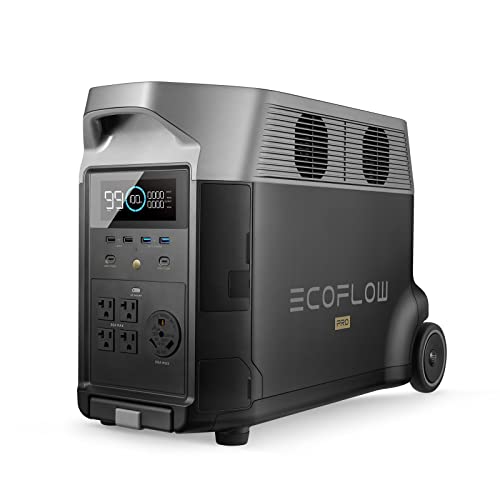


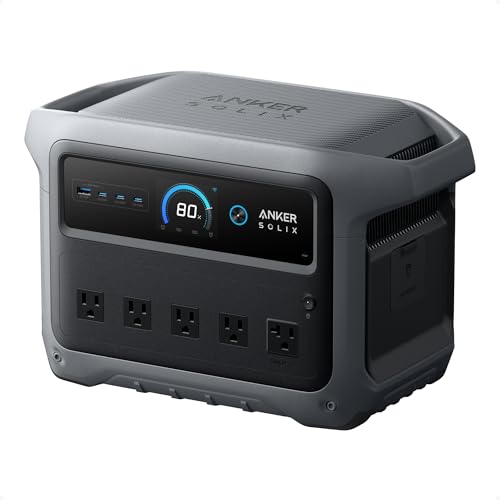


Links go to the exact base unit in the table, not a bundle. Amazon prices change daily.
No confirmed Amazon listing for the exact base unit, so we do not link a guess: Anker SOLIX C2000 Gen 2, Bluetti AC200Max, EcoFlow DELTA 2 Max, Bluetti AC180P, Jackery Explorer 1000 Plus, EcoFlow DELTA 2, Anker SOLIX C800, Bluetti EB3A. Listed but not linked here, because they do not clear this job: Bluetti AC70, EcoFlow RIVER 2 Pro, Bluetti Elite 30 V2, EcoFlow RIVER 3 Plus, Anker SOLIX C300, EcoFlow RIVER 2, EcoFlow RIVER 3.
Head-to-head comparisons of these units
- Bluetti AC200L vs Bluetti Elite 200 V2
- Bluetti AC180 vs EcoFlow DELTA 3 Plus
- Bluetti AC180 vs Bluetti Elite 100 V2
- Anker SOLIX C1000 Gen 2 vs Jackery Explorer 1000 v2
- Bluetti Elite 100 V2 vs EcoFlow DELTA 3
- Bluetti AC180 vs EcoFlow DELTA 3
- Anker SOLIX C1000 vs EcoFlow DELTA 3 Plus
- Anker SOLIX C2000 Gen 2 vs Jackery Explorer 2000 v2
- Anker SOLIX C1000 vs Bluetti Elite 100 V2
- Bluetti AC200L vs Bluetti AC200Max
- EcoFlow DELTA 3 vs EcoFlow DELTA 3 Plus
- EcoFlow DELTA 3 vs Jackery Explorer 1000 v2
- Bluetti AC180 vs Jackery Explorer 1000 v2
- EcoFlow DELTA 2 vs Jackery Explorer 1000 v2
- Anker SOLIX C1000 vs Bluetti AC180
- EcoFlow DELTA 2 vs EcoFlow DELTA 3
- Bluetti AC180 vs EcoFlow DELTA 2
- Anker SOLIX C1000 vs EcoFlow DELTA 2
- Anker SOLIX C1000 vs Jackery Explorer 1000 v2
- Anker SOLIX C1000 vs EcoFlow DELTA 3
If you were considering a gasoline generator instead
A properly sized gasoline generator will start almost any household motor and run it for days on fuel. It also kills people every year when it is run indoors, in a garage, or near a window, and the official count keeps rising after first publication:
Generator carbon monoxide deaths: the CPSC revision matrix.
Ordering before a storm? Check the arrival date at checkout — a unit that ships tomorrow can beat a better one that ships next week. Amazon Prime includes fast delivery on eligible items and starts with a free trial; we earn a commission if you join.
Sources and method
Rated capacity, continuous output and surge ratings are manufacturer-published figures, each traced to a sentence on the maker’s product or bundle listing and checked on 2026-08-23 and 2026-08-24; the listing, the date and the footnotes are given per unit on the comparison pages. Runtime is calculated by CalmWatt, not measured. Our full method is in How we verify; more comparisons are on the
Comparisons page.