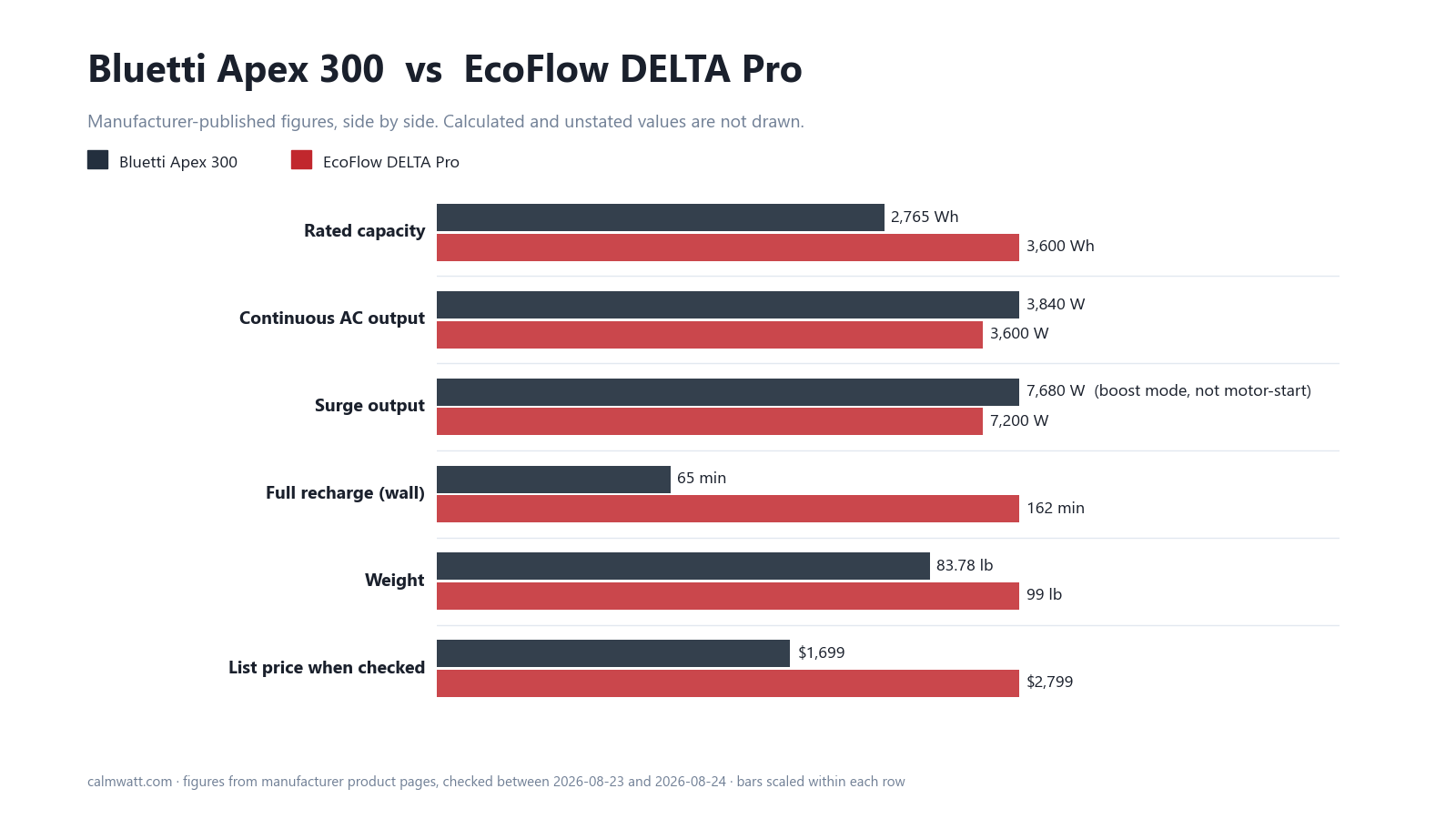
Specifications checked against manufacturer pages on 2026-08-23.
The Bluetti Apex 300 (2,764.8 Wh, 3,840 W) and the EcoFlow DELTA Pro (3,600 Wh, 3,600 W), compared on the figures their makers publish. On the normalized ratios, the Apex 300 costs less per watt-hour ($0.61/Wh vs $0.78/Wh); the DELTA Pro carries more per pound (36.4 Wh/lb vs 33.0 Wh/lb).
In short. The Apex 300 leads on cost per watt-hour ($0.61/Wh vs $0.78/Wh), recharge rate (42.5 Wh/min vs 22.2 Wh/min), rated cycle life (6,000 vs 3,500) and continuous watts per dollar (2.26 W/$ vs 1.29 W/$). The DELTA Pro leads on watt-hours per pound (36.4 Wh/lb vs 33.0 Wh/lb). 1 of 6 measures ties or is not comparable.
Check the current price

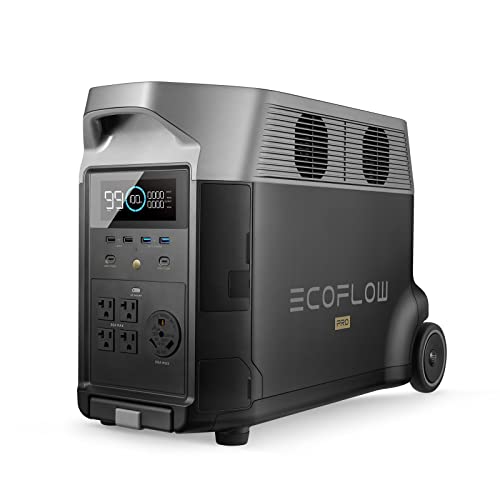
Links go to the exact base unit we compared, not a bundle. Amazon prices change daily.
Specifications, side by side
Numbered notes below the table give the source location or a caveat for figures that need one; check marks mark the better figure where one can be judged; “Manufacturer does not state” means absent from that maker’s page as of its check date listed under Sources. UPS switchover is how long the outlets go dark when grid power drops.
| Specification | Bluetti Apex 300 | EcoFlow DELTA Pro |
|---|---|---|
| Rated capacity | 2,764.8 Wh1 | 3,600 Wh2 ✓ |
| Usable capacity (calculated)* | 2350–2488 Wh | 3060–3240 Wh |
| Continuous AC output | 3,840 W3 ✓ | 3,600 W4 |
| Surge output | No conventional surge stated (7,680 W boost mode)5 | 7,200 W6 |
| Full recharge from wall | 65 min7 ✓ | 162 min8 |
| Cell chemistry | LiFePO49 | LFP10 |
| Rated cycle life | 6,000+ cycles to 80%11,12 ✓ | 3,500 cycles to 80%13,14 |
| UPS switchover | 0 ms15 | Manufacturer does not state |
| Expandable | Yes, up to 58,061 Wh16,17 | Yes, up to 25,000 Wh18,19 |
| Max solar input | 2,400 W20 ✓ | 1,600 W21 |
| Max AC charging input | 3,840 W22 ✓ | 3,000 W23 |
| AC outlets | 624 ✓ | 525 |
| Highest USB-C port | 100 W26 | 100 W27 |
| App control | Yes28 | Manufacturer does not state |
| Stated noise | Manufacturer does not state | 48–60 dB29 |
| Warranty | 5 years30 | 3 years31 |
| Weight | 83.78 lb32 ✓ | about 99 lb33 |
| Manufacturer list price when checked | $1,69934 ✓ | $2,79935 |
* Calculated: rated capacity × an assumed 85–90% conversion efficiency; no maker publishes a usable figure.
Notes on the figures
- Apex 300, rated capacity: Tech Specs > OUTPUT row for the Apex 300 block. The hero also states ‘2,764.8Wh Capacity’.
- DELTA Pro, rated capacity: Rated capacity of the base unit before any extra batteries are added.
- Apex 300, continuous output: Tech Specs > OUTPUT. Hero also shows ‘3,840W Output’. Continuous AC output; 120V/240V dual voltage.
- DELTA Pro, continuous output: Rated continuous AC output across all outlets combined; an X-Boost mode supports resistive devices up to 4,500 W.
- Apex 300, surge: This is BLUETTI’s ‘Lifting Power’ (Power Lifting mode for resistive loads), not a conventional surge rating. A bundle description on the same page says ‘3.8kW continuous output, capable of driving up to 7680W pure resistive load’; a caption on one image calls it ‘7,680W surge power’. It is not a conventional motor-start surge rating and should not be read as one.
- DELTA Pro, surge: Conventional surge rating; the page separately markets a boost mode of 4500 W for resistive loads.
- Apex 300, full recharge: Full (0-100%) time applies to Turbo Charging mode (3,840W Max.). The Tech Specs INPUT row only states ‘Turbo Charging 3,840W Max. (80% in 45 mins @ 59°F to 77°F /15°C to 25°C)’. Standard AC mode is ‘up to 1,440W’ (FAQ Q11) with no full-charge time stated; the ‘ AC Input’ row reads ‘120V, 50/60Hz, 15A Max. 1,800W Max. with bypass’.
- DELTA Pro, full recharge: Full recharge from a standard wall outlet at 1,800 W takes 2.7 hours (162 minutes), the figure we use; the maker also states 1.7 hours at an EV charging station (3,400 W) and 1.9 hours with dual AC plus solar charging.
- Apex 300, cell chemistry: Tech Specs > BATTERY INFO. Marketing copy: ‘2nd-gen automotive-grade LiFePO₄ battery built to last 17 years’.
- DELTA Pro, cell chemistry: LFP is lithium iron phosphate chemistry.
- Apex 300, cycle life: Stated as ‘6,000+’, a lower bound rather than an exact count.
- Apex 300, cycle life: Cycle Life 6,000+ cycles to 80% original capacity
- DELTA Pro, cycle life: To 80% of original capacity; the same specification line also states 6,500 cycles to 50% capacity.
- DELTA Pro, cycle life: Remaining-capacity endpoint paired with the 3,500-cycle figure; the maker also states 6,500 cycles to a 50% endpoint.
- Apex 300, UPS switchover: Conditional: a footnote on the page reads ‘0ms UPS* keeps work online instantly. … *Connect to grid power with the 15A AC charging cable, set output to 240V, and plug essential devices into the left two AC outlets.’ Elsewhere: ‘Fast 0ms or 20ms switching keeps sensitive devices like CPAP machines running smoothly.’ So 0 ms applies only in that configuration; otherwise 20 ms. Not in the Tech Specs table.
- Apex 300, expandable: Tech Specs > GENERAL. Compatible expansion batteries per the page: B300K, B300S, B300, B500K.
- Apex 300, expandable: FAQ answer for a 3-unit parallel system via Hub A1 (also ‘Max AC output: 11,520W (3 units)’). Marketing: ‘Super scalable: 2,764.8Wh to 58kWh capacity’. A single Apex 300 supports up to 6 batteries per unit, but no verbatim single-unit maximum Wh is stated on the page.
- DELTA Pro, expandable: Each unit supports up to two DELTA Pro Smart Extra Batteries or Smart Generators.
- DELTA Pro, expandable: Upper bound for a whole-system setup that requires two DELTA Pro units with extra battery packs plus two Smart Generators; a single DELTA Pro with two extra batteries reaches 10.8 kWh.
- Apex 300, solar input: Two built-in XT60 solar inputs totaling 2,400W (FAQ: ‘Each input port supports up to 1,200W (12V-60V*, 20A Max.), totaling 2,400W.’). With the optional SolarX 4K accessory the page claims ‘up to 4,000W solar input* (* Requires a SolarX 4K.)’ and ‘a maximum solar input of 6,400W’ combined; SolarX 4K also requires at least one B300K.
- DELTA Pro, solar input: Maximum solar charging input; the solar input voltage range is 11-150 V at up to 15 A.
- Apex 300, AC input: Maximum AC charging rate in Turbo mode (FAQ Q11: ‘Turbo (up to 3,840W)’; ‘Standard (up to 1,440W)’). The separate ‘ AC Input’ spec row reads ‘120V, 50/60Hz, 15A Max. 1,800W Max. with bypass’ for the 15A cable. ‘Maximum Input’ row: ‘Apex 300: 3,840W Max. Apex 300+1~6 B300K: 6,240W Max.’
- DELTA Pro, AC input: Maximum AC input at 240 V; on a standard 120 V outlet the maximum is 1,800 W.
- Apex 300, AC outlets: Count derived from the row: 4 x 20A household outlets + 1 x NEMA TT-30R + 1 x NEMA 14-50R = 6 AC receptacles.
- DELTA Pro, AC outlets: The specifications table lists five AC outlets; the page’s FAQ separately counts four 20 A household AC outlets among the unit’s output ports.
- Apex 300, USB-C: The Apex 300 itself has no USB-C ports; the 2 x 100W USB-C ports require the optional Hub D1 accessory.
- DELTA Pro, USB-C: Per port; the unit has two USB-C ports.
- Apex 300, app: Tech Specs > GENERAL. BLUETTI app features listed: remote on/off, monitoring, mode switching, OTA updates, multi-device management, Extreme Weather Alerts.
- DELTA Pro, noise: Measured at a 1-meter distance; the level varies with the wattage flowing in or out of the battery and with temperature.
- Apex 300, warranty: Tech Specs > GENERAL for the Apex 300 block (expansion batteries on the same page carry different terms, e.g. B500K ‘4 Years’).
- DELTA Pro, warranty: EcoFlow states a 3-year standard warranty; a 2-year extension requires EcoFlow App registration, so per our policy we count the base three years.
- Apex 300, weight: Tech Specs > GENERAL for the Apex 300 block (the label carries a stray leading space on the page). Other weights on the page (45kg/99.21lbs, 1.59kg/3.51lbs) belong to B500K and Charger 2 and were ignored.
- DELTA Pro, weight: Approximate net weight stated by the manufacturer.
- Apex 300, price: Price shown in the ‘Select Options’ picker for the single-unit ‘Apex 300’ option (the currency symbol and the number are rendered separately on the page).
- DELTA Pro, price: List price; a sale price of $1,899 was shown, and a members-only final price of $1,799 was also advertised.
The same specs, normalized
Ratios, so the bigger unit does not win by default.
| Measure | Apex 300 | DELTA Pro |
|---|---|---|
| Cost per watt-hour | $0.61/Wh ✓ | $0.78/Wh |
| Watt-hours per pound | 33.0 Wh/lb | 36.4 Wh/lb ✓ |
| Surge headroom | Not comparable — the Apex 300 figure is a boost-mode rating, not a motor-start surge. | |
| Recharge rate | 42.5 Wh/min ✓ | 22.2 Wh/min |
| Rated cycle life | 6,000 ✓ | 3,500 |
| Continuous watts per dollar | 2.26 W/$ ✓ | 1.29 W/$ |
Definitions and direction of each ratio: How we verify.
What each one runs, for how long
| Appliance | Apex 300 | DELTA Pro |
|---|---|---|
| Full-size refrigerator 150 W, 900 W start, 35% duty · eff. 70%–82% |
37–43 hr | 2.0–2.3 days |
| Mini fridge 70 W, 400 W start, 30% duty · eff. 70%–82% |
3.8–4.5 days | 5.0–5.9 days |
| CPAP without humidifier 40 W · eff. 70%–82% |
2.0–2.4 days | 2.6–3.1 days |
| CPAP with heated humidifier 95 W · eff. 70%–82% |
20–24 hr | 27–31 hr |
| Gas furnace blower 400 W, 1600 W start, 40% duty · eff. 80%–87% |
14–15 hr | 18–20 hr |
| 1/3 hp sump pump 500 W, 1800 W start, 15% duty · eff. 80%–87% |
29–32 hr | 38–42 hr |
| Router and modem 20 W · eff. 70%–82% |
4.0–4.7 days | 5.2–6.1 days |
| Laptop 60 W · eff. 70%–82% |
32–38 hr | 1.8–2.1 days |
| 1500W space heater 1500 W · eff. 85%–90% |
1.6–1.7 hr | 2.0–2.2 hr |
Calculated, not measured: hours = rated Wh × efficiency ÷ (appliance W × duty); assumptions on How we verify. “Unlikely to start”: start-up surge exceeds the stated surge rating.
What the differences mean
Price per watt-hour. At the list prices we checked, the Apex 300 costs $0.61/Wh against $0.78/Wh for the DELTA Pro. At list the Apex 300 is $1,100 cheaper ($1,699 vs $2,799) for 2,764.8 Wh vs 3,600 Wh. Prices move with sales; the ratio moves with them.
Weight for the capacity. The DELTA Pro carries 36.4 Wh/lb against 33.0 Wh/lb for the Apex 300. Both are cart-or-two-people units; the difference matters if the unit moves between car, porch and basement.
Recharge. The Apex 300 completes a wall recharge in 65 minutes against 162 for the DELTA Pro — about 97 fewer minutes of generator run time per charge in a multi-day outage.
Cycle rating. The Apex 300 is rated for 6,000 cycles against 3,500 for the DELTA Pro, both to the same remaining-capacity threshold — otherwise we would not compare them. At one full cycle a week the difference is measured in years, not months; at occasional outage use neither limit is reached.
Output for the money. 2.26 W/$ on the Apex 300 against 1.29 W/$ on the DELTA Pro: read this row first if the job is powering one heavy load rather than trickling many light ones.
Which one, and for whom
On normalized measures the Apex 300 leads on cost per watt-hour ($0.61/Wh vs $0.78/Wh), recharge rate (42.5 Wh/min vs 22.2 Wh/min), rated cycle life (6,000 vs 3,500) and continuous watts per dollar (2.26 W/$ vs 1.29 W/$). The DELTA Pro answers on watt-hours per pound (36.4 Wh/lb vs 33.0 Wh/lb). Which figure settles it depends on what you need to keep running:
- CPAP overnight. Switchover: Apex 300 0 ms, DELTA Pro no UPS figure stated. A 40 W CPAP runs roughly 2.0–2.4 days on the Apex 300 and 2.6–3.1 days on the DELTA Pro. Both run the night; the DELTA Pro states no UPS figure, which matters more overnight than the hour difference.
- Keeping a refrigerator cold. Check start-up before runtime. The Apex 300 states a boost figure rather than a motor-start surge rating; the DELTA Pro states a 7,200 W surge rating. A full-size refrigerator needs about 900 W to start.
- A multi-day outage with a generator or solar to recharge from. Full recharge: Apex 300 65 min, DELTA Pro 162 min. The faster unit spends less generator fuel per charge.
Check the current price
Links go to the exact base unit we compared, not a bundle. Amazon prices change daily.
Related reading
A 2,764.8–3,600 Wh battery cannot do what a gasoline generator does — the runtime table shows a 1,500 W space heater emptying either unit in 1.6–2.2 hr — but it also cannot poison a household. The safety half of that trade-off is in our CPSC revision matrix of generator carbon-monoxide death counts, and this page puts every verified unit on the same refrigerator scenario.
Other comparisons with these models
Ordering before a storm? Check the arrival date at checkout — a unit that ships tomorrow can beat a better one that ships next week. Amazon Prime includes fast delivery on eligible items and starts with a free trial; we earn a commission if you join.
Sources and method
- Bluetti Apex 300: manufacturer product page, checked 2026-08-23.
- EcoFlow DELTA Pro: manufacturer product page, checked 2026-08-24.
Published specifications only; no bench tests. Method: How we verify. More: Comparisons.