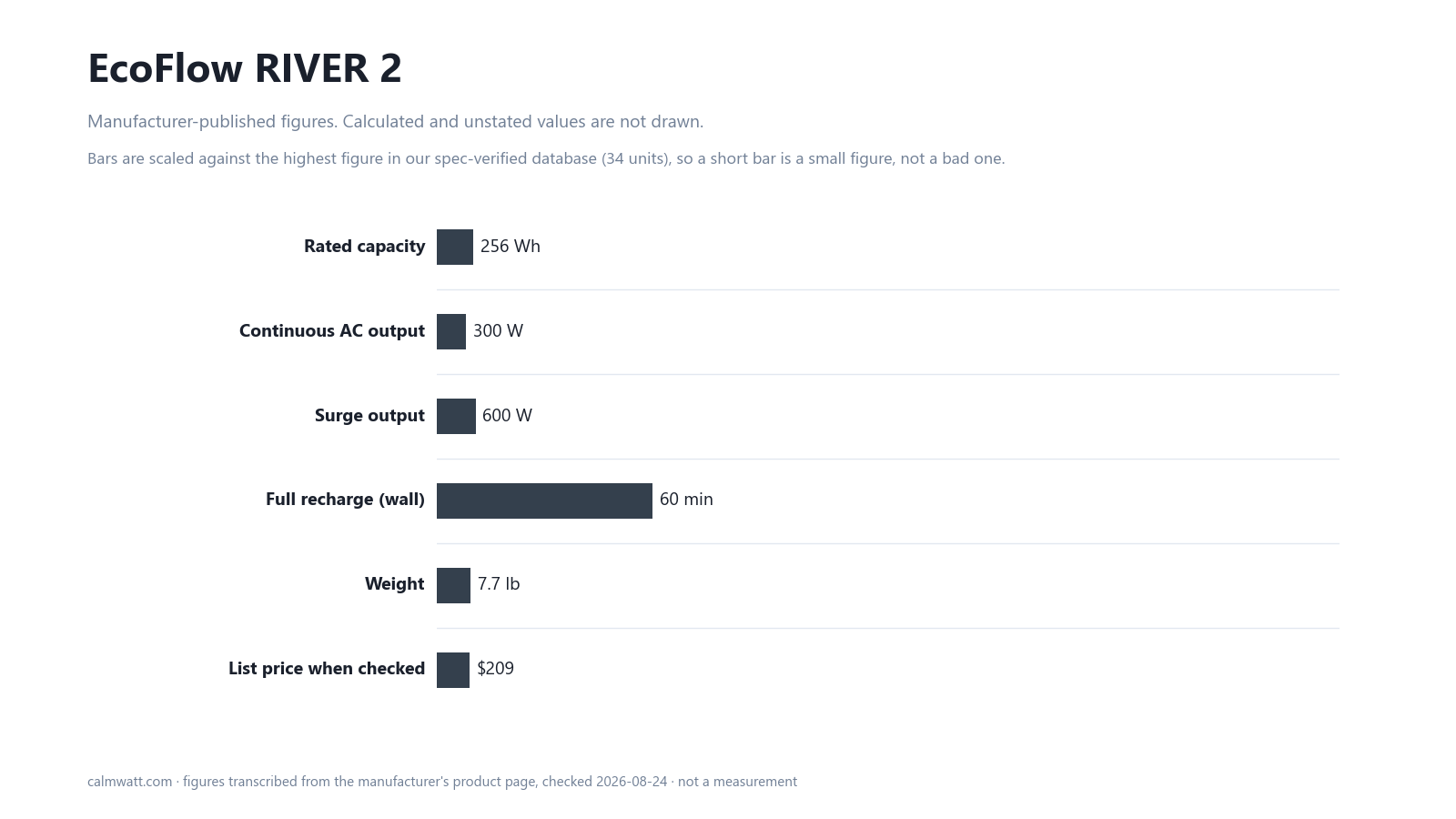
Specifications checked against manufacturer pages on 2026-08-24.
The EcoFlow RIVER 2 is a 256 Wh portable power station in the compact bracket, with a 300 W continuous inverter and LFP (LiFePO4) cells. This page transcribes the manufacturer’s specifications as they stood on 2026-08-24, turns the capacity into appliance hours, and names the rows EcoFlow does not fill in. Quoted figures carry a source; calculated ones carry a formula.
In short. 256 Wh in the compact band: $0.82/Wh at the list price we recorded; 33.2 Wh per pound; 3,000 rated cycles to 80%+. On our assumptions published figures say it is unlikely to start a full-size refrigerator, and a 40 W CPAP calculates to 5.1–5.6 hr. We could not fill 3 rows from EcoFlow’s page. They are listed below, not guessed. Hours are calculated from rated capacity, never measured.
Check the current price

The link goes to the exact base unit whose specifications are on this page, not a bundle. Amazon prices change daily.
Who it is for, and who should skip it
Two lists, both drawn from the table further down.
It fits if
- The unit has to move. 7.7 lb is a one-hand carry rather than a cart job, so car to porch to basement is realistic.
Skip it if
- You want resistive heat. A 1,500 W heater is above the 300 W continuous rating; it will not run.
- A refrigerator through a whole working day. On a typical full-size unit this is unlikely to start; that job wants the next size up.
- Whole-house backup. This is a single-appliance unit, not a standby generator, and it is not wired to your panel.
Every published specification
Each footnote below points at the sentence a figure came from. Two phrases matter: “Manufacturer does not state” means the maker is silent, “Not yet verified by CalmWatt” means we are.
| Specification | EcoFlow RIVER 2 |
|---|---|
| Rated capacity | 256 Wh1 |
| Usable capacity (calculated)* | 218–230 Wh |
| Continuous AC output | 300 W2 |
| Surge output | 600 W3 |
| Full recharge from wall | 60 min4 |
| Cell chemistry | LFP (LiFePO4)5 |
| Rated cycle life | 3,000 cycles to 80%+6,7 |
| UPS switchover | 30 ms8 |
| Expandable | Manufacturer does not state |
| Max solar input | 110 W9 |
| Max AC charging input | 360 W10 |
| AC outlets | Manufacturer does not state |
| Highest USB-C port | 60 W11 |
| App control | Yes12 |
| Stated noise | Manufacturer does not state |
| Warranty | 5 years13 |
| Weight | about 7.7 lb14 |
| Manufacturer list price when checked | $20915 |
* Our calculation, not a published figure: rated capacity × an assumed 85–90% conversion efficiency.
Notes on the figures
- RIVER 2, rated capacity: Rated capacity as listed on the manufacturer’s spec sheet.
- RIVER 2, continuous output: Continuous AC output at 120 V, 50/60 Hz.
- RIVER 2, surge: Stated in the AC output line of the spec sheet.
- RIVER 2, full recharge: Full 0-100% recharge from a wall outlet as stated by the manufacturer.
- RIVER 2, cell chemistry: The spec sheet lists the cell chemistry as LFP (lithium iron phosphate).
- RIVER 2, cycle life: The battery retains at least 80% of its capacity after 3,000 charge cycles.
- RIVER 2, cycle life: This threshold comes from the same statement as the cycle-life figure.
- RIVER 2, UPS switchover: EcoFlow describes this as an emergency power source (EPS) switch-over rather than a true uninterruptible power supply, and advises against relying on it for sensitive electronics such as data servers.
- RIVER 2, solar input: Maximum solar charging input, at 11-30 V and up to 8 A.
- RIVER 2, AC input: Maximum AC wall-charging input.
- RIVER 2, USB-C: The USB-C port serves as both input and output at up to 60 W.
- RIVER 2, app: The spec sheet lists app control over Wi-Fi and Bluetooth via the EcoFlow app.
- RIVER 2, warranty: Warranty length as stated on the product page.
- RIVER 2, weight: Stated as an approximate net weight.
- RIVER 2, price: Price shown on the product page at the time of checking; no separate list or sale price was displayed.
What EcoFlow does not state
A specification sheet is as informative in what it omits as in what it lists. Every gap on this unit’s page, named rather than quietly filled in. That places it with the 29 of 34 transcribed units that leave a gap; this one leaves 3 figures.
- Expandable combo. Absent from EcoFlow’s specifications for this unit when we checked.
- The number of ac outlets. Absent from EcoFlow’s specifications for this unit when we checked.
- Operating noise. Absent from EcoFlow’s specifications for this unit when we checked.
- Usable capacity. No maker in our database publishes one. Rated capacity is the cells; what reaches the outlet is less, and the gap moves with the load.
None of this makes the unit worse than its rivals; most makers omit most of these. It does mean any page quoting a confident number for one of them is quoting an estimate.
What it runs, and for how long
Same appliances and assumptions we use on every comparison page, so these rows read against any other unit on this site.
| Appliance | RIVER 2 |
|---|---|
| Full-size refrigerator 150 W, 900 W start, 35% duty · eff. 85%–90% |
Unlikely to start |
| Mini fridge 70 W, 400 W start, 30% duty · eff. 85%–90% |
10–11 hr |
| CPAP without humidifier 40 W · eff. 80%–87% |
5.1–5.6 hr |
| CPAP with heated humidifier 95 W · eff. 85%–90% |
2.3–2.4 hr |
| Gas furnace blower 400 W, 1600 W start, 40% duty |
Will not run |
| 1/3 hp sump pump 500 W, 1800 W start, 15% duty |
Will not run |
| Router and modem 20 W · eff. 80%–87% |
10–11 hr |
| Laptop 60 W · eff. 85%–90% |
3.6–3.8 hr |
| 1500W space heater 1500 W |
Will not run |
Arithmetic, not a measurement: hours = rated Wh × efficiency ÷ (appliance W × duty). Appliance and efficiency assumptions live on How we verify. A row reading “Unlikely to start” failed the surge check, not the capacity one.
The same specs, normalized
| Measure | RIVER 2 |
|---|---|
| Cost per watt-hour | $0.82/Wh |
| Watt-hours per pound | 33.2 Wh/lb |
| Surge headroom | 2.00× |
| Recharge rate | 4.3 Wh/min |
| Rated cycle life | 3,000 cycles to 80%+ |
| Continuous watts per dollar | 1.44 W/$ |
Ratios have no winner here — there is no second column. Each one is defined, with its direction, on How we verify.
What those figures actually mean
Cost per watt-hour: $0.82/Wh. The $209 list price we recorded over 256 Wh of rated capacity. This is the number to carry between listings; a discount changes it in proportion, so ours is only true for the day we recorded it.
Watt-hours per pound: 33.2 Wh/lb. 256 Wh in 7.7 lb makes this a one-hand carry. Density is what lithium iron phosphate gives up to older chemistries; the cycle rating is what it buys in return.
Surge headroom: 2.00×. A stated 600 W surge over a 300 W continuous rating, which is the figure to check against your own appliance’s start-up draw. Capacity is irrelevant if the motor never turns.
Recharge rate: 4.3 Wh/min. A full wall charge in 60 minutes. In a multi-day outage this is generator fuel measured in minutes.
Rated cycle life: 3,000 cycles to 80%+ capacity. Cycled weekly it would take about 58 years to get there, so for a few outages a year the cell count is not the limit. For daily off-grid use it is. The percentage matters as much as the count: two ratings only compare when they name the same remaining capacity.
Continuous watts per dollar: 1.44 W/$. Output for the money rather than storage for the money. Which of the two you should read depends on whether your outage is a big load or a long one.
Where it sits in our database
The obvious missing question on a one-unit page is whether these numbers are good. Here is where each lands among the units we have verified.
| Measure | RIVER 2 | Among verified units |
|---|---|---|
| Rated capacity | 256 Wh | 33rd largest of 34 |
| Continuous AC output | 300 W | 33rd highest of 34 |
| Cost per watt-hour | $0.82/Wh | 25th cheapest of 32 |
| Watt-hours per pound | 33.2 Wh/lb | 22nd densest of 34 |
| Weight | 7.7 lb | 1st lightest of 34 |
A low rank on weight is a high rank on portability. Nothing in this table is a verdict. The row built on price uses the manufacturer list price recorded on 2026-08-24; the retail price behind our link moves independently, so recompute that row against what you are shown.
Three outages, and the figure that decides each
- One night, one CPAP. A 40 W CPAP without a humidifier calculates to 5.1–5.6 hr. The stated 30 ms handover is what decides whether the machine notices the outage.
- Twelve hours, one refrigerator. Published figures say the compressor is unlikely to start, so the hours never come into play.
- The loads people forget. A gas furnace blower will not run at all and a one-third horsepower sump pump will not run at all. Neither is a cord-and-plug load in a typical house, whatever these hours say. A router and modem, meanwhile, calculates to 10–11 hr.
- Three days, with something to recharge from. A full wall recharge takes 60 minutes, and it accepts up to 110 W of solar, so day two turns on your panels and your sky.
The RIVER 2 against other units
2 pages on this site compare the RIVER 2 directly with another unit, using the table above on both sides.
Questions people ask about the RIVER 2
Answers use only the figures on this page.
How long will the RIVER 2 run a refrigerator?
Is unlikely to start on our assumptions for a typical full-size unit at 150 W running and a 35% duty cycle. Start-up is the check that comes before hours. Your own compliance label is the number that matters.
Can the RIVER 2 run a CPAP all night?
A 40 W machine without a humidifier calculates to 5.1–5.6 hr on our assumptions, against the eight hours a night usually needs. The maker states 30 ms on the handover. A heated humidifier roughly doubles the draw.
How long does the RIVER 2 take to recharge?
60 minutes from a wall outlet on the maker’s figure, with up to 110 W accepted from solar. In a long outage that sets how long a generator runs per refill.
How much does the RIVER 2 weigh?
7.7 lb on the maker’s figure, or 33.2 Wh of rated capacity carried per pound. That is a one-hand carry, so it moves with you rather than living in one place.
How many cycles is the RIVER 2 rated for?
3,000 cycles to 80%+ of original capacity, on LFP (LiFePO4) cells, which is roughly 58 years at one cycle a week. Compare it only with ratings quoted to the same remaining capacity.
Will the RIVER 2 run a space heater?
No. A 1,500 W heater is above the 300 W continuous rating.
Check the current price
The link goes to the exact base unit whose specifications are on this page, not a bundle. Amazon prices change daily.
Related reading
Against a gasoline generator this loses on endurance — its continuous rating does not cover a 1,500 W space heater at all — and wins on the one thing that kills people every winter. Our CPSC revision matrix tracks how the official count of generator carbon-monoxide deaths has changed across report editions, and this page puts every verified unit, including this one, on one refrigerator scenario.
Ordering before a storm? Check the arrival date at checkout — a unit that ships tomorrow can beat a better one that ships next week. Amazon Prime includes fast delivery on eligible items and starts with a free trial; we earn a commission if you join.
Sources and method
- EcoFlow RIVER 2: manufacturer product page, checked 2026-08-24.
We compared published specs and copied each figure from the manufacturer’s page. Runtimes are our arithmetic, not a measurement, and the formula is on the page so you can substitute your own load. Method: How we verify. More: Comparisons.