Specifications checked against manufacturer pages between 2026-08-23 and 2026-09-12.
In an RV the load that decides everything is the rooftop air conditioner, and what decides whether it runs is continuous output, not capacity. This page ranks our spec-verified units by continuous AC output, with rated capacity as the tiebreak, and says plainly what we cannot verify about RV wiring.
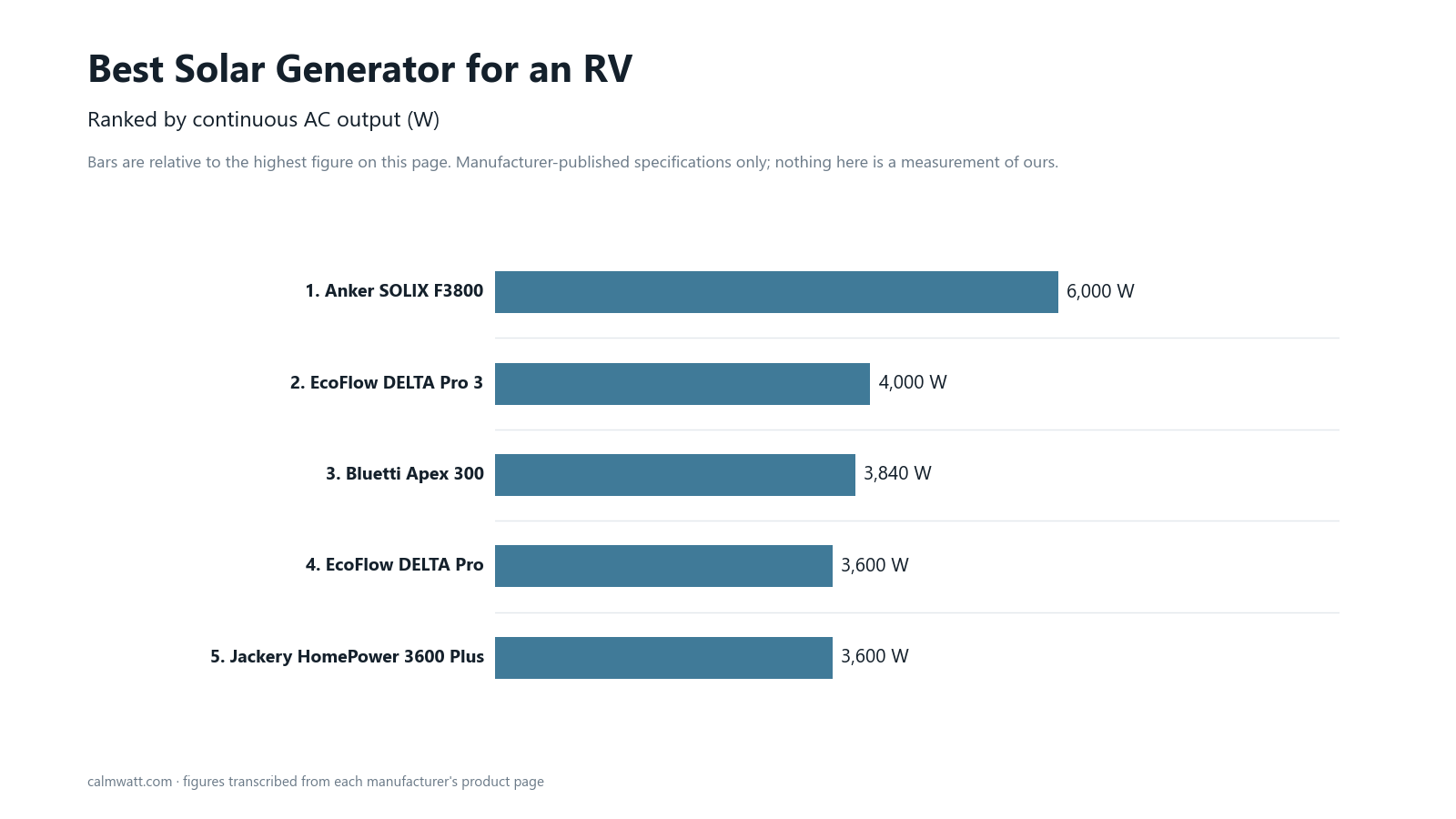
Our picks. Anker SOLIX F3800, EcoFlow DELTA Pro 3, Bluetti Apex 300. The order comes from a single calculation applied the same way to every unit: We rank by continuous AC output first, then by surge rating, then by rated capacity. Every figure below was transcribed from the manufacturer’s own page between 2026-08-23 and 2026-09-12.
How we ranked them
We rank by continuous AC output first, then by surge rating, then by rated capacity. Continuous output and surge are separate axes because they answer separate questions: continuous output is what a load draws once it is running, surge is the brief spike when a compressor or motor starts. A unit can clear one and fail the other, so we rank on both rather than letting a high continuous figure hide a thin start-up margin. We do not state what any particular air conditioner draws: that figure belongs on your unit’s own nameplate, and we do not have a manufacturer source for it to quote.
A ranking is only honest if the rule is visible. Ours is one line, the table carries the inputs, and nobody paid to appear here.
One thing the phrase “solar generator” hides: every price below is for the power station alone. Solar panels are sold separately, and a panel kit often costs as much again as the unit. We link the bare unit because that is the product whose specifications we transcribed; budget for panels on top.
We do not claim any unit fits a 30-amp RV inlet. No maker in our database states a TT-30 connection or a 30-amp transfer rating for these units, so neither do we. If your plan is to feed the coach through its shore-power inlet, that is an adapter-and-wiring question to settle before buying, not a specification we can verify from published figures.
1. Anker SOLIX F3800
3,840 Wh · 6,000 W continuous · 132.3 lb · $2,199.99 list when checked
Why it places 1st. Continuous AC output of 6,000 W, the highest of the units we have verified. That is 50% more than DELTA Pro 3 just below it (4,000 W). Anker SOLIX states a 9,000 W surge for start-up loads.
Anker SOLIX publishes a limit alongside that unit’s figures — on its continuous output, “the 240V output cannot be used while the device is charging via 120V AC”. A number without the limit its maker put on it is not the whole number, so we carry it here rather than in a footnote.
Behind that output sits 3,840 Wh, which is what decides how long the load runs once it starts.
Two reference loads, both calculated: a 150 W full-size refrigerator calculates to 2.1–2.5 days, a 40 W CPAP without humidifier calculates to 2.8–3.3 days.
Take one more load buyers ask about, a mini fridge (70 W, 400 W start): it calculates to 5.3–6.2 days.
Anker SOLIX does not publish the remaining-capacity level its cycle rating refers to, operating noise and a full wall-charge time for this unit, so those rows stay empty rather than filled with someone’s estimate.
2. EcoFlow DELTA Pro 3
4,096 Wh · 4,000 W continuous · 113.54 lb · $3,699 list when checked
Why it places 2nd. Continuous AC output of 4,000 W, 2nd highest of the units we have verified. That is 4% more than Apex 300 just below it (3,840 W). EcoFlow states an 8,000 W surge for start-up loads.
Behind that output sits 4,096 Wh, which is what decides how long the load runs once it starts.
On our assumptions a 150 W full-size refrigerator calculates to 2.3–2.7 days and a 40 W CPAP without humidifier calculates to 3.0–3.5 days. Both are calculated from the rated capacity, not measured.
On a second load many buyers run at the same time, a mini fridge (70 W, 400 W start), it calculates to 5.7–6.7 days.
A full wall-charge time goes unstated by EcoFlow here. We leave the gap visible instead of quietly closing it.
3. Bluetti Apex 300
2,764.8 Wh · 3,840 W continuous · 83.78 lb · $1,699 list when checked
Why it places 3rd. Continuous AC output of 3,840 W, 3rd highest of the units we have verified. That is 7% more than DELTA Pro just below it (3,600 W). Bluetti publishes a boost figure rather than a motor-start surge, so published numbers cannot confirm it starts a compressor.
Behind that output sits 2,764.8 Wh, which is what decides how long the load runs once it starts.
Put against household loads it calculates to 37–43 hr on a 150 W full-size refrigerator and calculates to 2.0–2.4 days on a 40 W CPAP without humidifier — arithmetic on the rated capacity, not a bench result.
For a different load off the same battery — a mini fridge, 70 W, 400 W start — the same arithmetic calculates to 3.8–4.5 days.
What Bluetti omits for this unit: operating noise. An empty row is more useful than a guess.
4. EcoFlow DELTA Pro
3,600 Wh · 3,600 W continuous · 99 lb · $2,799 list when checked
Why it places 4th. Continuous AC output of 3,600 W, 4th highest of the units we have verified. It is level with HomePower 3600 Plus on this measure (3,600 W); the tie is broken by the figures in the table. EcoFlow states a 7,200 W surge for start-up loads.
Behind that output sits 3,600 Wh, which is what decides how long the load runs once it starts.
On our assumptions a 150 W full-size refrigerator calculates to 2.0–2.3 days and a 40 W CPAP without humidifier calculates to 2.6–3.1 days. Both are calculated from the rated capacity, not measured.
On a second load many buyers run at the same time, a mini fridge (70 W, 400 W start), it calculates to 5.0–5.9 days.
Whether the unit has app control and UPS switchover time go unstated by EcoFlow here. We leave the gap visible instead of quietly closing it.
5. Jackery HomePower 3600 Plus
3,584 Wh · 3,600 W continuous · 77.16 lb · $1,899 list when checked
Why it places 5th. Continuous AC output of 3,600 W, 5th highest of the units we have verified. It is level with DELTA Pro on this measure (3,600 W); the tie is broken by the figures in the table. Jackery states a 7,200 W surge for start-up loads.
Behind that output sits 3,584 Wh, which is what decides how long the load runs once it starts.
Two reference loads, both calculated: a 150 W full-size refrigerator calculates to 2.0–2.3 days, a 40 W CPAP without humidifier calculates to 2.6–3.1 days.
Take one more load buyers ask about, a mini fridge (70 W, 400 W start): it calculates to 5.0–5.8 days.
Jackery does not publish maximum AC charging input and whether the unit has app control for this unit, so those rows stay empty rather than filled with someone’s estimate.
The five side by side
| Unit | Continuous AC output | Rated capacity | Continuous | Weight | List price |
|---|---|---|---|---|---|
| 1. Anker SOLIX F3800 | 6,000 W | 3,840 Wh | 6,000 W | 132.3 lb | $2,199.99 |
| 2. EcoFlow DELTA Pro 3 | 4,000 W | 4,096 Wh | 4,000 W | 113.54 lb | $3,699 |
| 3. Bluetti Apex 300 | 3,840 W | 2,764.8 Wh | 3,840 W | 83.78 lb | $1,699 |
| 4. EcoFlow DELTA Pro | 3,600 W | 3,600 Wh | 3,600 W | 99 lb | $2,799 |
| 5. Jackery HomePower 3600 Plus | 3,600 W | 3,584 Wh | 3,600 W | 77.16 lb | $1,899 |
No links in this table on purpose: it is here to be read, not clicked. Prices are the manufacturer list figures we recorded, not what a retailer charges today.
Across the 27 units we have both transcribed and can link, the top five run from 6,000 W down to 3,600 W — a 40% spread on the measure this page ranks. The spread is wide enough that the order matters more than the usual tie-breakers. The other columns do not follow this one, so the table is there to be read across rather than down.
What would change this ranking
Continuous output is a fixed specification, so this order is the most stable of our lists: it moves only when a maker ships a new model or restates a rating. What it does not capture is whether your air conditioner’s start-up surge clears, which depends on the compressor rather than on the number we rank by. Because the rule is one line, you can apply a different one: swap the wattage we assume and the order moves accordingly.
We rebuild this page from the same ledger that produces every other page on the site, so when a figure changes for F3800 or any unit here, it changes everywhere at once rather than only where someone remembered to edit it.
What we did not pick
Every unit we considered and did not pick, with the reason:
- Jackery Explorer 2000 Plus, Bluetti Elite 200 V2, Bluetti AC200L, Jackery HomePower 2000 Plus v2, Anker SOLIX C2000 Gen 2, Jackery Explorer 2000 v2, Jackery HomePower 3600 Pro Max, Anker SOLIX C1000 Gen 2, and 14 more — ranked below the top 5 on continuous AC output.
That is 22 units set aside against 5 ranked above, out of the 27 we can both link directly and check against the maker’s own page. A unit we cannot do both for never reaches this page at all, which is why the total here is smaller than the market.
Questions people ask
No answer here introduces a number you cannot check above.
How did you rank these?
One rule, applied identically to each unit: We rank by continuous AC output first, then by surge rating, then by rated capacity. The table shows the number each unit scored.
Do these prices include solar panels?
No. Every price is for the power station on its own. Panels are sold separately and a panel kit can cost as much as the unit, so budget for both.
How long will the F3800 run a refrigerator?
It calculates to 2.1–2.5 days against our reference refrigerator — 150 W running at a 35% duty cycle. Substitute the wattage from your own door label to get your figure.
Have you used these units?
We have not. Everything here is a published specification or a calculation from one, labelled as such at the point it appears.
Why are some units missing?
Two reasons. We only list units whose specifications we have transcribed from the maker’s own page, and we only link products we can point at directly. A unit we cannot link does not appear at all.
What does “continuous AC output” mean here?
We rank by continuous AC output first, then by surge rating, then by rated capacity. Nothing else affects the ranking.
Ordering before a storm? Check the arrival date at checkout — a unit that ships tomorrow can beat a better one that ships next week. Amazon Prime includes fast delivery on eligible items and starts with a free trial; we earn a commission if you join.
Sources and method
Specifications come from each manufacturer’s own product page, transcribed with the source sentence recorded, and checked between 2026-08-23 and 2026-09-12. Runtimes are calculated, never measured: rated capacity and an assumed efficiency, both stated above. Method: How we verify. Per-unit detail: Comparisons.