Specifications checked against manufacturer pages between 2026-08-23 and 2026-09-12.
Camping is the one use where weight decides more than capacity. A unit that carries twice the energy is no help if it stays in the trunk. This page ranks our spec-verified units by watt-hours carried per pound, which is the ratio that separates a pack-in unit from a drive-up one, and prints the maker’s stated noise figure where one exists.
Our picks. Jackery Explorer 2000 v2, Jackery HomePower 2000 Plus v2, Anker SOLIX C2000 Gen 2. They are ordered by one measure and nothing else: We rank by watt-hours per pound: rated capacity divided by the manufacturer’s stated weight. Nothing below is estimated: the figures were read off the makers’ pages between 2026-08-23 and 2026-09-12.
How we ranked them
We rank by watt-hours per pound: rated capacity divided by the manufacturer’s stated weight. Noise matters at a campsite, so we print each maker’s stated figure where there is one. We do not rank on it: four of the units we cover state no noise figure at all, and ranking on a number most makers omit would punish them for our gap rather than theirs.
Watt-hours per pound is a ratio, and a ratio has no arms. A unit can rank high here and still be too heavy to carry from the car to a site, so read the pound figure next to every entry, not just the ratio.
The point of naming the measure is that you can reject it. The table keeps every raw figure, so a reader who cares about a different column can rank on that one instead. No unit paid for its place.
1. Jackery Explorer 2000 v2
2,042 Wh · 2,200 W continuous · 39.5 lb · $999 list when checked
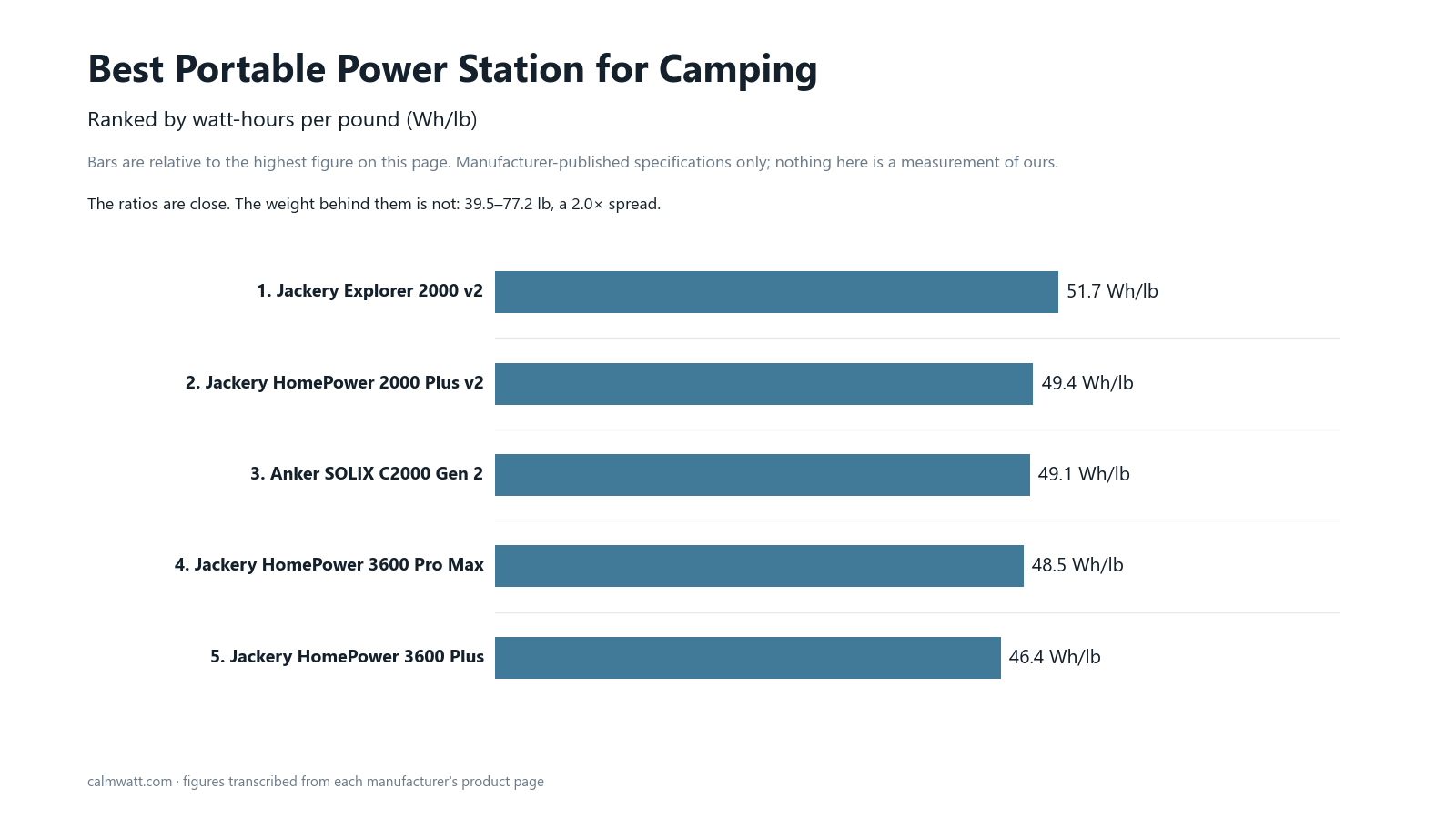
Why it places 1st. Watt-hours per pound of 51.7 Wh/lb, the highest of the units we have verified. That is 5% more than HomePower 2000 Plus v2 just below it (49.4 Wh/lb). Its stated 4,400 W surge covers the roughly 900 W a full-size refrigerator draws to start.
At 39.5 lb it is a two-hands lift. Stated noise: 30 dB in its Quiet Mode, measured at one metre, and 45 dB at full load — the maker’s own figure and the maker’s own condition, which differs between units on this page.
Two reference loads, both calculated: a 150 W full-size refrigerator calculates to 31–34 hr, a 40 W CPAP without humidifier calculates to 36–42 hr.
For the small loads that actually fill a trip, it calculates to 79–93 charges of a typical phone battery, assuming 18 Wh a charge and the same conversion efficiency band we use everywhere else. Phones are the load that makes a heavy unit feel wasteful and a light one feel sufficient.
Jackery does not publish maximum AC charging input for this unit, so that row stays empty rather than filled with someone’s estimate.
2. Jackery HomePower 2000 Plus v2
2,048 Wh · 2,400 W continuous · 41.45 lb · $1,199 list when checked
Why it places 2nd. Watt-hours per pound of 49.4 Wh/lb, 2nd highest of the units we have verified. That is 1% more than C2000 Gen 2 just below it (49.1 Wh/lb). Its stated 4,800 W surge covers the roughly 900 W a full-size refrigerator draws to start.
At 41.45 lb it is a cart-or-two-people unit. Stated noise: 30 dB — the maker’s own figure and the maker’s own condition, which differs between units on this page.
On our assumptions a 150 W full-size refrigerator calculates to 31–34 hr and a 40 W CPAP without humidifier calculates to 36–42 hr. Both are calculated from the rated capacity, not measured.
Against the load a trip actually runs, the arithmetic gives 80–93 charges of a phone battery at 18 Wh a charge, on the same efficiency band as every other figure here. Phone charging is where a small unit stops feeling small.
Maximum AC charging input, a full wall-charge time and UPS switchover time go unstated by Jackery here. We leave the gap visible instead of quietly closing it.
3. Anker SOLIX C2000 Gen 2
2,048 Wh · 2,400 W continuous · 41.7 lb · $999.99 list when checked
Why it places 3rd. Watt-hours per pound of 49.1 Wh/lb, 3rd highest of the units we have verified. That is 1% more than HomePower 3600 Pro Max just below it (48.5 Wh/lb). Its stated 4,000 W surge covers the roughly 900 W a full-size refrigerator draws to start.
At 41.7 lb it is a cart-or-two-people unit. Stated noise: 30 dB at loads under 1,000 W — the maker’s own figure and the maker’s own condition, which differs between units on this page.
Put against household loads it calculates to 31–34 hr on a 150 W full-size refrigerator and calculates to 36–42 hr on a 40 W CPAP without humidifier — arithmetic on the rated capacity, not a bench result.
Counted in phone charges — 18 Wh each, same efficiency band as the rest of this page — it works out to 80–93 charges. That is the load most trips spend their capacity on, whatever else is packed.
4. Jackery HomePower 3600 Pro Max
3,584 Wh · 2,000 W continuous · 73.85 lb · $2,099 list when checked
Why it places 4th. Watt-hours per pound of 48.5 Wh/lb, 4th highest of the units we have verified. That is 4% more than HomePower 3600 Plus just below it (46.4 Wh/lb). Its stated 4,000 W surge covers the roughly 900 W a full-size refrigerator draws to start.
At 73.85 lb it is a cart-or-two-people unit, 1.9 times the weight of the lightest unit on this page. Stated noise: under 30 dB in its Quiet Mode, measured at one metre — the maker’s own figure and the maker’s own condition, which differs between units on this page.
Two reference loads, both calculated: a 150 W full-size refrigerator calculates to 2.3–2.5 days, a 40 W CPAP without humidifier calculates to 2.6–3.1 days.
For the small loads that actually fill a trip, it calculates to 139–163 charges of a typical phone battery, assuming 18 Wh a charge and the same conversion efficiency band we use everywhere else. Phones are the load that makes a heavy unit feel wasteful and a light one feel sufficient.
Jackery does not publish maximum AC charging input and maximum solar input for this unit, so those rows stay empty rather than filled with someone’s estimate.
5. Jackery HomePower 3600 Plus
3,584 Wh · 3,600 W continuous · 77.16 lb · $1,899 list when checked
Why it places 5th. Watt-hours per pound of 46.4 Wh/lb, 5th highest of the units we have verified. That is 4% less than HomePower 3600 Pro Max above it (48.5 Wh/lb). Its stated 7,200 W surge covers the roughly 900 W a full-size refrigerator draws to start.
At 77.16 lb it is a cart-or-two-people unit, 2.0 times the weight of the lightest unit on this page. Stated noise: 30 dB — the maker’s own figure and the maker’s own condition, which differs between units on this page.
Put against household loads it calculates to 2.0–2.3 days on a 150 W full-size refrigerator and calculates to 2.6–3.1 days on a 40 W CPAP without humidifier — arithmetic on the rated capacity, not a bench result.
Counted in phone charges — 18 Wh each, same efficiency band as the rest of this page — it works out to 139–163 charges. That is the load most trips spend their capacity on, whatever else is packed.
What Jackery omits for this unit: maximum AC charging input and whether the unit has app control. An empty row is more useful than a guess.
The five side by side
| Unit | Watt-hours per pound | Rated capacity | Continuous | Weight | List price |
|---|---|---|---|---|---|
| 1. Jackery Explorer 2000 v2 | 51.7 Wh/lb | 2,042 Wh | 2,200 W | 39.5 lb | $999 |
| 2. Jackery HomePower 2000 Plus v2 | 49.4 Wh/lb | 2,048 Wh | 2,400 W | 41.45 lb | $1,199 |
| 3. Anker SOLIX C2000 Gen 2 | 49.1 Wh/lb | 2,048 Wh | 2,400 W | 41.7 lb | $999.99 |
| 4. Jackery HomePower 3600 Pro Max | 48.5 Wh/lb | 3,584 Wh | 2,000 W | 73.85 lb | $2,099 |
| 5. Jackery HomePower 3600 Plus | 46.4 Wh/lb | 3,584 Wh | 3,600 W | 77.16 lb | $1,899 |
We keep the table plain and unlinked so it can be checked at a glance. Every price is a manufacturer list figure recorded on the date given above.
Across the 27 units we have both transcribed and can link, the top five run from 51.7 Wh/lb down to 46.4 Wh/lb — a 10% spread on the measure this page ranks. The ratio spans only 10%, but the weight behind it runs from 39.5 to 77.16 lb — 2.0 times as much. A close ratio does not mean a close object. Every other figure in the table moves independently of that one, which is why the table carries them.
What would change this ranking
This ranking ignores price entirely, so a sale changes nothing about the order. What would change it is a maker restating weight — several publish an ‘approx.’ figure — or a new unit in the same capacity class landing lighter. Noise would change which unit we would pick for a quiet campsite, but it does not enter the ranking. Our assumptions are printed above so you can substitute your own. If you change the appliance wattage or the duty cycle, the order can change with it.
Because the ranking is computed from the ledger rather than written by hand, a revision to Explorer 2000 v2’s specifications reorders this list automatically.
What we did not pick
A list that only shows winners hides how the winners were chosen.
- Jackery Explorer 1000 v2, Jackery HomePower 1000 Plus v2, EcoFlow RIVER 2 Pro, Anker SOLIX C1000 Gen 2, Bluetti Elite 100 V2, Bluetti Elite 200 V2, EcoFlow DELTA 2, Anker SOLIX C1000, and 14 more — ranked below the top 5 on watt-hours per pound.
That is 22 units set aside against 5 ranked above, out of the 27 we can both link directly and check against the maker’s own page. A unit we cannot do both for never reaches this page at all, which is why the total here is smaller than the market.
Weight is published by every maker we cover, so nothing is excluded for that reason.
Questions people ask
Every answer below is drawn from the table above.
How did you rank these?
With a single calculation: We rank by watt-hours per pound: rated capacity divided by the manufacturer’s stated weight. No judgement is layered on top, and every input is printed in the table.
Does the price cover panels as well?
It does not. The figures are for the station alone; panels add a second purchase that can approach the price of the unit.
How long will the Explorer 2000 v2 run a refrigerator?
A typical full-size refrigerator calculates to 31–34 hr on our assumptions: 150 W running, a 35% duty cycle, and an assumed conversion efficiency. Your own compliance label is the number that matters.
Did you test any of these?
No. This site transcribes manufacturer figures and does arithmetic on them. We own no test bench and do not pretend otherwise.
What stops a unit from appearing?
A model appears only if both are true: we hold its figures from the maker’s own page, and we can point a link at that exact product rather than something close to it.
What does “watt-hours per pound” mean here?
We rank by watt-hours per pound: rated capacity divided by the manufacturer’s stated weight. It is the only measure that sets the order on this page.
Ordering before a storm? Check the arrival date at checkout — a unit that ships tomorrow can beat a better one that ships next week. Amazon Prime includes fast delivery on eligible items and starts with a free trial; we earn a commission if you join.
Sources and method
Figures are the manufacturers’ own, transcribed between 2026-08-23 and 2026-09-12, each kept beside the sentence that carried it. Anything described as a runtime is CalmWatt arithmetic on the rated capacity, not a bench result. Method: How we verify. Per-unit detail: Comparisons.